
Many investors breathed a sigh of relief at having survived (and even thrived) the turbulent economic and political events of 2025.
Super funds posted strong double-digit returns for the 2024-2025 financial year. Australia recorded modest economic growth, while inflation cooled a little throughout the year – albeit with a slight uptick at year’s end – and house prices surged before hitting the brakes
The big picture
Markets and economies around the world have danced to the tune of the Trump Administration’s second term in office and reacted to wars and unrest in the Middle East and Ukraine.
The US President’s often surprising policy twists and turns, particularly a punishing new tariff regime, saw markets falter and exporters of goods and services to the US plunged into uncertainty. As one commentator put it: “Over the past 12 months, the US has seen every norm of economic policy – trade policy, fiscal policy, monetary policy – blithely tossed aside.”
The Australian dollar reflected the choppy conditions, hitting lows just under 0.60 USD in April before recovering slightly by year-end at just under 0.67 USD, this was buoyed by our strong iron ore exports and the growing demand for lithium, copper and rare earths.
The artificial intelligence revolution was another feature of the year, driving US share markets ever higher with some fearing the bubble is overdue to burst.
Economy
Inflation’s stubborn resistance to the Reserve Bank’s measures to bring it down could lead to further interest rate rises in 2026.
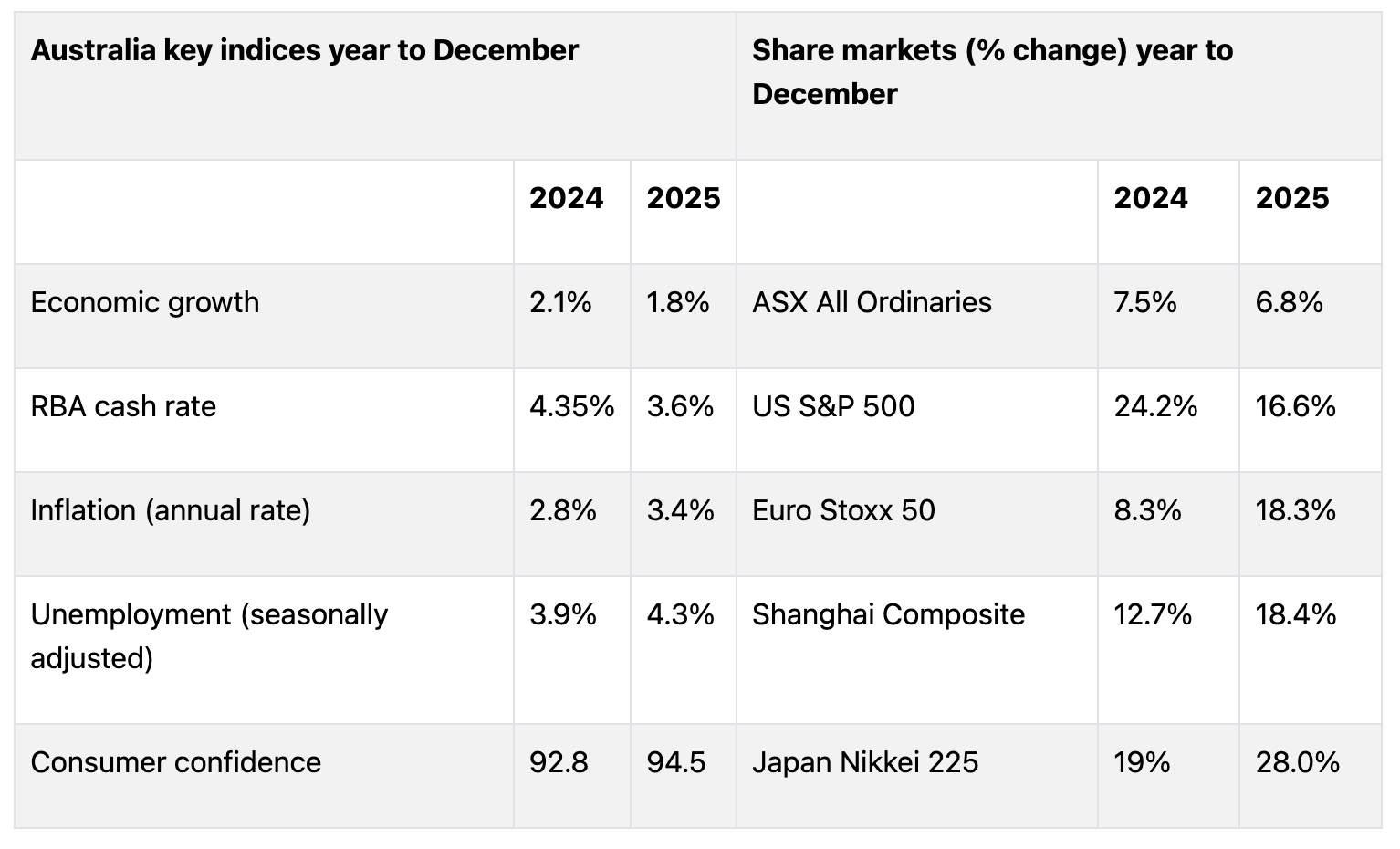
The Consumer Price Index eased slightly in November 2025, while figures released in early January 2026 showed an annual rate of 3.4%, down 0.4% on the previous month. The RBA’s flexible inflation target aims to keep the cost of living increases between 2 and 3 %
The cash rate began 2025 at 4.35% but after three cuts during the year, it was down to 3.6% in December. The RBA is due to meet in February to consider its next move.
In the US, the Federal Reserve also cut rates three times, putting the interest rate to a range of 3.5 – 3.75%.
The Australian economy grew 2.1% in the year to September in a massive improvement on the previous year’s growth of 0.8%.
Property
After two uneven years, home values surged again in 2025 by 8.6%, adding about $71,500 to the national median.iii
It’s the strongest calendar year performance since the remarkable 24.5% increase in 2021.
However, values softened in December, recording the smallest monthly increase in five months, and some suggest the risk of further rate rises this year may keep prices in check.
Share markets
Global equity markets proved that they could thrive, even in a higher-interest rate environment, and the AI revolution moved from the hype phase of the previous year to serious players in 2025.
While ‘The Magnificent Seven’ tech stocks have long ruled the S&P 500, in 2025 just two outperformed the index with a gain of 64.8% for Alphabet and 38.9% for Nvidia.
It was a slower pace for Australian markets with the S&P/ASX 200 delivering a solid total return of 6.8%. While the big banks faced some pressure on margins as interest rates peaked, the materials sector was supported by the global energy transition. Dividend yields remained attractive, continuing Australia’s tradition of providing reliable income for retirees and SMSFs.
Commodities
Precious metals drove commodity values in the past year with investors looking for security amid interest rate movements and geopolitical tensions.
Meanwhile, gold’s safe haven status during times of uncertainty saw it jump by 65% during the year.
Continued demand from China kept the price of iron ore steadily increasing in the last half of 2025.
Looking ahead
It seems likely the issues that dominated the financial markets in 2025 may continue to shape performance and returns this year.
Global politics and war are likely to move commodity prices and equity markets while the contrariness of US foreign policy will both spook and buoy investors.
AI capability and implementation will grow apace, which is likely to see action on equity markets, but don’t forget warnings that the bubble may burst.
In Australia, all eyes will be on the RBA, with high levels of speculation as to where interest rates will be heading in 2026.