
Integrity One

Your Complete Financial Solution

  • Home
  • News
  • Services
    • Financial Planning Services
    • Aged Care
    • Finance & Mortgage
    • Centrelink & DVA
    • Accounting & Taxation
    • Business Advisory Services
    • Planning for Success
    • Gen X,Y & Z
  • Small Business Portal
  • About Us
    • Our Team
    • Financial Services Guide
  • Contact Us

Quarterly property update – June 2023

June 5, 2023

Has Australia’s housing downturn come to an end?

Interest rates have been the hot topic of conversation among homebuyers for a year now. In May 2022 the RBA made its first tactical move, raising the official rate for the first time since November 2010. And it’s all we’ve seemed to hear about since – with much speculation as to whether the RBA will increase rates or hit “pause”.

As a result of rate increases, home values slipped across the country for the best part of 2022, only beginning to rebound modestly in recent months. Some industry experts believe the worst of the rates hikes could be behind us, while others are taking a ‘wait and see’ approach. In any case the property market appears to be reacting with optimism, with June’s CoreLogic Home Value Index showing the strongest monthly growth since November 2021.

Capital city uplift

Figures released by CoreLogic at the start of June showed the third monthly rise in national housing values with each of the four largest capitals recording a lift over the quarter. After falling -9.1% between May 2022 and February 2023, have Australian housing values finally bottomed out? “Our anticipation is the market will continue to level out on the expectation that interest rates have peaked and the imbalance between housing demand and supply will persist for some time yet,” Mr Lawless wrote in the May Home Value Index (HVI), citing the significant lift in overseas migration will likely put further strain on availability.

Eleanor Creagh, senior economic at PropTrack, said interest rates cannot solely be held responsible for market sentiment. “This stabilisation in the housing market has occurred despite further rate rises. It appears the impact of interest rate rises is being counterbalanced by stronger housing demand and tight supply conditions,” she said in response to the May rate rise. “The surprise increase in interest rates is unlikely to outweigh these factors, though may dampen confidence in the nascent recovery and in the near-term impact the pace of monthly price increases.”

Ultimately, housing prices are on a knife’s edge while larger economic factors continue to fluctuate. “The path for home prices in the months ahead will be influenced by many factors, including the strength in housing demand, the level of supply hitting the market, as well as the trajectory of interest rates,” Ms Creagh added.

Dwelling values over the quarter

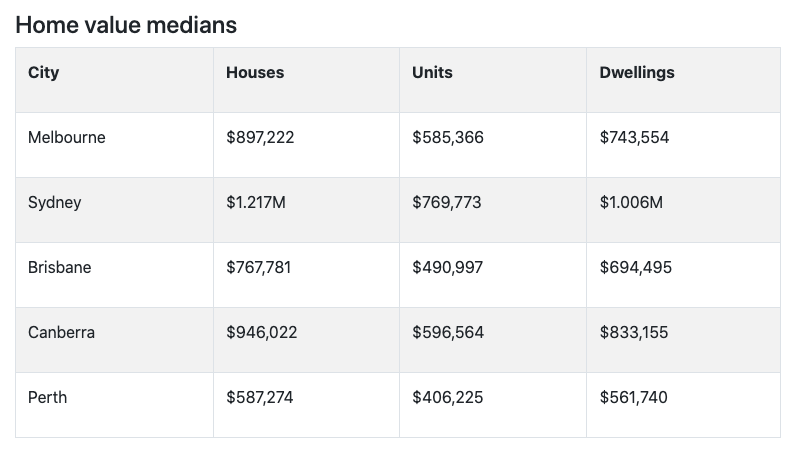
CoreLogic’s national HVI increased by 1.2% in May, following a 0.5% lift in April to be 2.3% higher over the quarter. The combined capital values have improved by 2.8% over the past three months while the combined regions improved by 0.8% during the same time period.

All signs are pointing to the fact the housing market has moved through an inflection point according to Mr Lawless. “Not only are we seeing housing values stabilising or rising across most areas of the country, a number of other indicators are confirming the positive shift. Auction clearance rates are holding slightly above the long run average, sentiment has lifted, and home sales are trending around the previous five-year average,” said Mr Lawless.

Sydney

Sydney is by far leading the positive turn in housing conditions, albeit coming from the deepest price slump. While the median dwelling value in the Harbour City is up 4.5% for the quarter, it’s still -13.8% down since its January 2022 Peak – the greatest peak to trough change in the country. Investors could take note that Sydney’s current gross rental yield sits at 3.2%.

Melbourne

Home to the mildest pandemic cycle in the country, the heavily locked down city experienced a 10.7% increase during that time. After the Victorian capital’s housing values peaked in February 2022, the market fell -9.6% to hit its trough by February this year. Now in recovery, Melbourne values have crept up 1.6% this quarter. In Melbourne, the gross rental yield is currently 3.5%.

Brisbane

After going through one of the most impressive Covid booms in the country as values soared an incredible 41.8%, Brisbane’s peak arrived in June 2022. The bottom of the local market came in February this year with a -11% cyclical fall, but values have since corrected, recording an increase of 1.8% over the quarter. For the Queensland capital, gross rental yields are sitting at 4.3%.

Canberra

Home values skyrocketed 38.8% during the post-pandemic run with a peak arriving in Canberra by June last year. The city has since seen values come off -9.5%, recording -0.1% this quarter and is now in its “cyclical trough” accord to CoreLogic data. Australia’s capital has a current gross rental yield of 4.1%.

Perth

The West Australian capital saw dwelling values jump by 24.5% during the recent boom. The peak to trough (July 2022 to February 2023) fall in Perth was only mild with a -0.9% change and since then values are already up by 2.4% in the last quarter. Home to the second highest rental yield in the country (only behind Darwin’s at 6.4%), Perth’s is sitting at 4.9%.
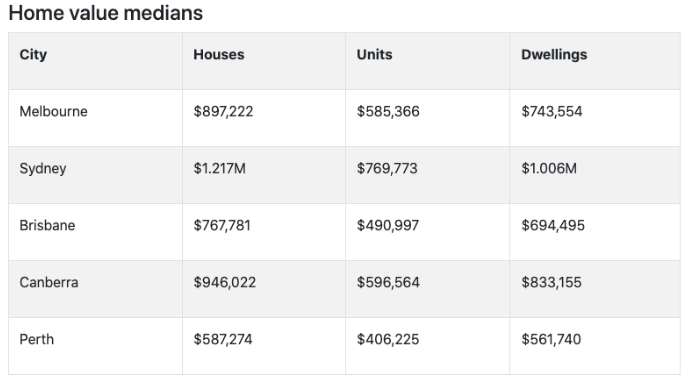
Note: all figures in the city snapshots are sourced from: Core Logic’s national Home Value Index (June 2023)

If you have any questions or need any information please give us a call on 039723 0522.

Nicholas Berry Credit Representative Number 472439 is a Credit Representative of Integrity Finance (Aust) Pty Ltd – Australian Credit Licence 392184.
This information is of a general nature and does not take into consideration anyone’s individual circumstances or objectives. Financial Planning activities only are provided by Integrity One Planning Services Pty Ltd as a Corporate Authorised Representative No. 315000 of Integrity Financial Planners Pty Ltd ABN 71 069 537 855 AFSL 225051. Integrity One Planning Services Pty Ltd and Integrity One Accounting and Business Advisory Services Pty Ltd are not liable for any financial loss resulting from decisions made based on this information. Please consult your adviser, finance specialist, broker, and/or accountant before making decisions using this information.

Suite 2, 1 Railway Crescent
Croydon, Victoria 3136

Email: integrityone@iplan.com.au

Telephone : 03 9723 0522
Integrity One Facebook

Integrity Edge Facebook

Filed Under: Blogs, News Tagged With: MB

Quarterly property update

March 6, 2023

The year in property has begun with some stabilisation in values

Australian property values appeared to stabilise with a 0.1% increase in national dwelling values for February. There was a –2.3% drop over the quarter according to CoreLogic’s national Home Value Index (HVI).

Although median property prices are still falling across the country there are signs some wind has come out of the housing downturn’s sails. While the 0.1% dip continues into negative territory, the February statistic was an improvement on the -1% fall seen in January, and was the smallest month-on-month decline since June.

All in all, CoreLogic’s Index is –9.1% off its April peak, making this the largest and fastest decline in values since 1980 when their record-keeping began. However, it pays to put this dwelling downturn in context. “Record declines in home values follow a record upswing, both in magnitude and speed. The national HVI was up a stunning 28.6% in the space of just 19 months,” said CoreLogic research director Tim Lawless.

“Despite the recent sharp drop in values, every capital city and rest-of-state region is still recording home values above pre-pandemic levels.

All eyes on interest rates

While they aren’t the only driver of the downturn, interest rates have played a major role in steering the ship. Once the Reserve Bank decides to hit the pause button – which is largely tipped to be in the first half of 2023 – economic experts predict housing values are likely to stabilise. Mr Lawless said there may be a few month’s lag before declines actually flatten out, but for a growth phase to begin the market needs to see some form of stimulation. “The most obvious stimulus would come from a drop in interest rates, but any cut to the cash rate probably won’t occur until late this year at the earliest.”

At its first meeting for 2023, the RBA increased the cash rate yet again by 0.25 percentage points on February 7, for the ninth time in a row, pushing the cash rate to a decade-high of 3.35%.

Top end price performance

The upper quartile of the combined capital city housing market drove this month’s stabilising trend, increasing by 0.1% in February.

This trend was most obvious across Sydney’s upper quartile, which recorded a 0.7% rise in values over the month, compared with a -0.2% fall in values across the lower quartile of the Sydney market. Upper quartile housing values have led the downturn to date, dropping -13.5% in value across the combined capital cities over the past 12 months, compared with a 1.7% rise in values across the lower quartile. Previous cycles have seen a similar trend, where the upper quartile tends to lead both the upswing and the downturn.

Regions still in favour

After extraordinary price growth in 2021, values in all regions are declining. Regional dwelling values were down -0.3% in February compared with a -0.1% fall across the combined capital cities. However, the weaker regional result relative to the combined capitals was mostly a factor of the monthly rise in Sydney housing values rather than a larger fall in regional market values.

Overall, CoreLogic recorded a combined regional market fall of -2.1% for the quarter to February 28. That’s a modest movement backwards after the combined non-capital city areas saw housing values surge 41.6% through the most recent upswing. Since peaking in June, the combined regionals index is only down -7.7%.

Melbourne

Melbourne’s median dwelling value is down –2.7% over the quarter. Data shows the Victorian capital has had a Covid trough to peak of 17.3%. After peaking in February 2022, the median dropped by -9.6%. Regionally, Victoria is –7.0% off its most recent peak in May 2022.

Sydney

The quarter to January’s close saw the median dwelling price in the Harbour City fall by –2.4%. Although In February Sydney was the only capital city to record an increase, gaining 0.3%. Sydney’s median peaked in January 2022 and has since experienced a -13.5% decline. The city’s trough to peak was 27.7%. After hitting its peak in May 2022, regional NSW closed the most recent quarter –10.1% off that high.

Brisbane

By February Brisbane’s median dwelling price was down –3.2% for the quarter. The capital of the Sunshine State had an exceptional trough to peak throughout the pandemic with the media skyrocketing 42.7%. Post peak in June 2022, the drop has been –11.0%. Across regional Queensland the median has come -7.3% off the June 2022 high.

Canberra

The ACT experienced a –2.7% decline of its median dwelling price during the three months to February’s end. Australia’s capital reached its price peak in June 2022 and has since come off the boil by –9.0%.

Perth

The Perth median appears to be plateauing with a modest quarterly move of just -0.2%. According to CoreLogic data the West Australian capital’s market only reached its peak in July 2022 and has come off just -0.9% since. The full trough to peak figure for Perth has been 25.9%. Regionally, the state is reportedly at its peak after experiencing a 32.4% increase through the recent growth phase.

Note: all figures in the city snapshots are sourced from: CoreLogic’s national Home Value Index (March 2023)

If you have any questions or need any information please give us a call on 039723 0522.

Nicholas Berry Credit Representative Number 472439 is a Credit Representative of Integrity Finance (Aust) Pty Ltd – Australian Credit Licence 392184.
This information is of a general nature and does not take into consideration anyone’s individual circumstances or objectives. Financial Planning activities only are provided by Integrity One Planning Services Pty Ltd as a Corporate Authorised Representative No. 315000 of Integrity Financial Planners Pty Ltd ABN 71 069 537 855 AFSL 225051. Integrity One Planning Services Pty Ltd and Integrity One Accounting and Business Advisory Services Pty Ltd are not liable for any financial loss resulting from decisions made based on this information. Please consult your adviser, finance specialist, broker, and/or accountant before making decisions using this information.

Suite 2, 1 Railway Crescent
Croydon, Victoria 3136

Email: integrityone@iplan.com.au

Telephone : 03 9723 0522

Integrity One Facebook

Integrity Edge Facebook

Filed Under: Blogs, News Tagged With: MB

  • « Previous Page
  • 1
  • …
  • 7
  • 8
  • 9
  • Home
  • What’s News
  • About Us
  • Financial Services Guide
  • Contact Us

Services

  • Financial Planning Services
  • Aged Care
  • Finance & Mortgage
  • Centrelink
  • Accounting and Taxation
  • Business Advisory Services
  • Gen X,Y & Z

Recent News items

Market movements & economic review – September 2026

Quarterly property update – September 2026

Why Transition to Retirement deserves a second look

All News items

Contact Us

Suite 2, 1 Railway Crescent
Croydon, Victoria 3136

Phone: (03) 9723 0522

Find us on Facebook

  • Home
  • Sitemap
  • Privacy
  • Complaints
  • Contact

All Rights Reserved 2016 Copyright Integrity one