Integrity One

Your Complete Financial Solution

  • Home
  • News
  • Services
    • Financial Planning Services
    • Aged Care
    • Finance & Mortgage
    • Centrelink & DVA
    • Accounting & Taxation
    • Business Advisory Services
    • Planning for Success
    • Gen X,Y & Z
  • Small Business Portal
  • About Us
    • Our Team
    • Financial Services Guide
  • Contact Us

Was life really better in the good old days?

July 13, 2026

  Key points

  • Angst about economic conditions has been running high in recent times. This is evident in chronically low consumer confidence readings and a downtrend in measures of happiness. It’s also arguably evident in the rise of populist parties globally and more recently in Australia.
  • There is no doubt that some things were better a generation or two ago. Cheaper housing stands out. But most indicators are far superior today.We are continuing to allow for a further rate hike in August and have another one pencilled in for November reflecting the still rising trend in underlying inflation and risks that it will take longer to bring it back under control,
  • That said there is no denying that “cost-of-living pressures” have been a problem in recent years and a key driver behind this has been poor productivity growth. Unfortunately, there are no quick and easy fixes to this.

Introduction

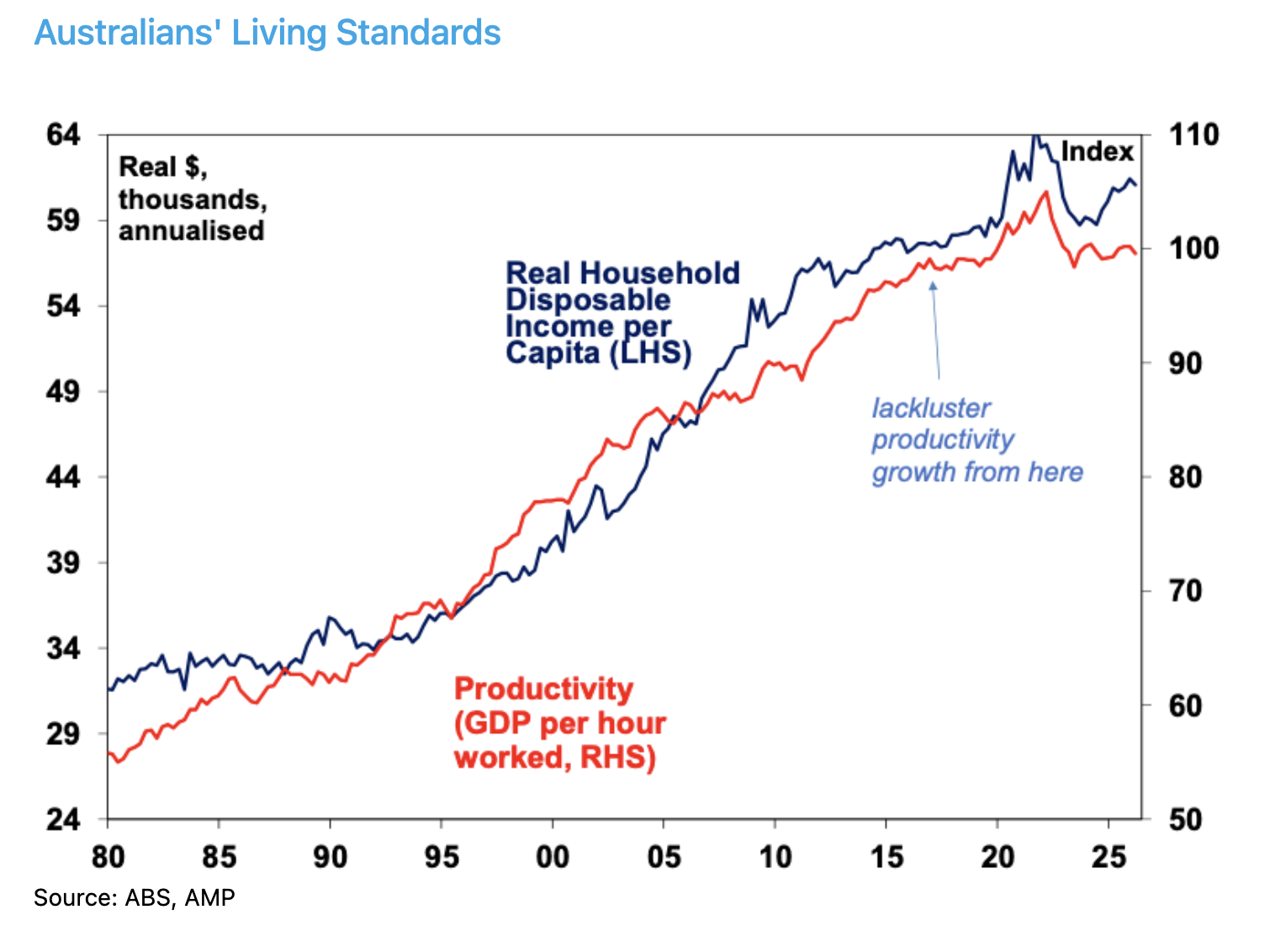
Lately, there seems to be a heightened level of angst that economic conditions are getting harder and that the two-party political system – and maybe democracy too – is failing voters. There seems to be a hankering for times past that some feel were better. There is no doubt that “cost-of-living” issues have become real in the post-pandemic years. This has been associated with relatively stagnant real household disposable income and poor productivity growth over the last decade. Unfortunately, there are no quick fixes to this. Rather getting productivity up requires hard-nosed economic reforms that may take years to bear fruit. But while the Australian economy does have some real challenges to address, it is worth keeping things in perspective. This note looks at how economic conditions in Australia have changed over the last half century.

Some things are worse today

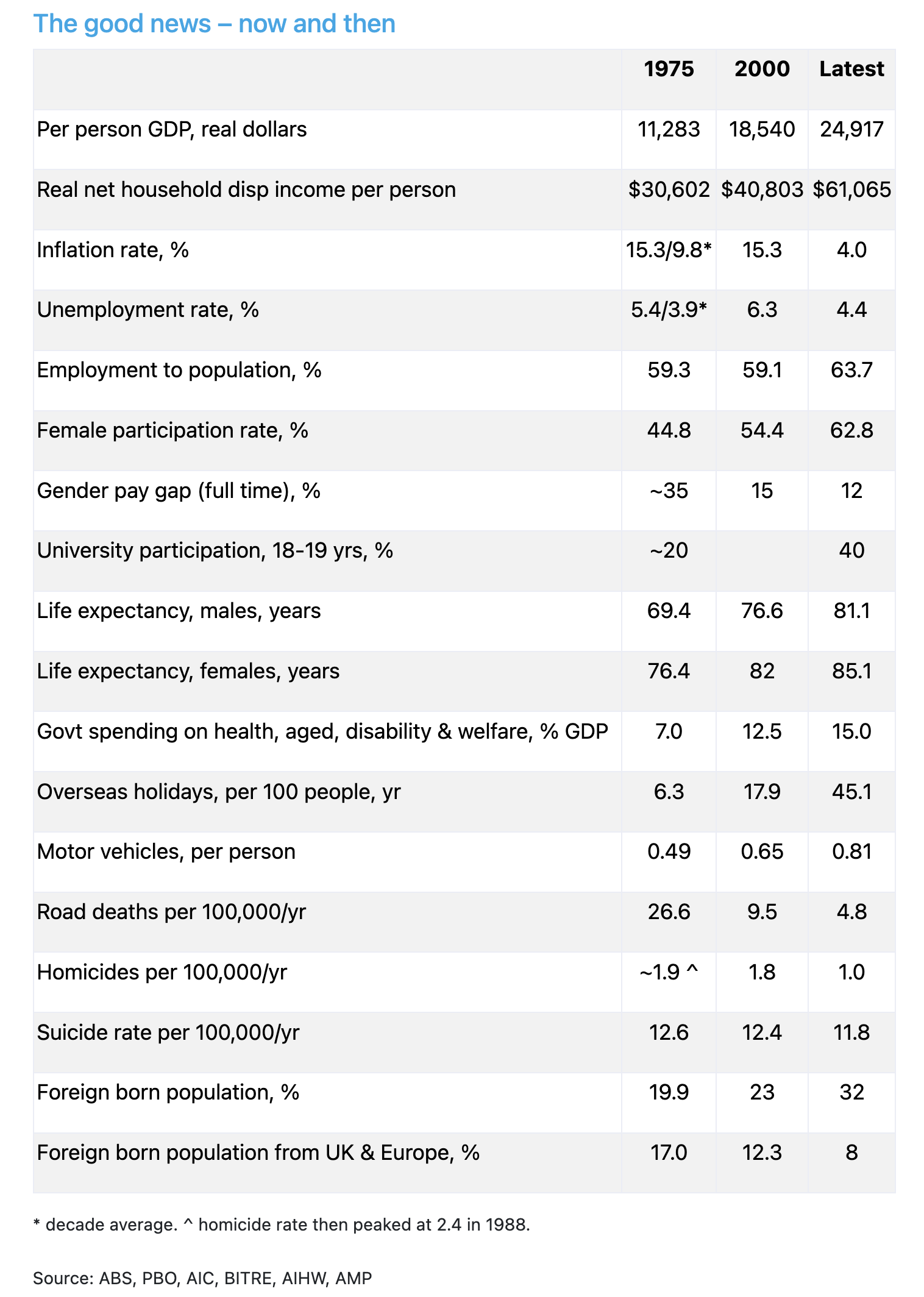
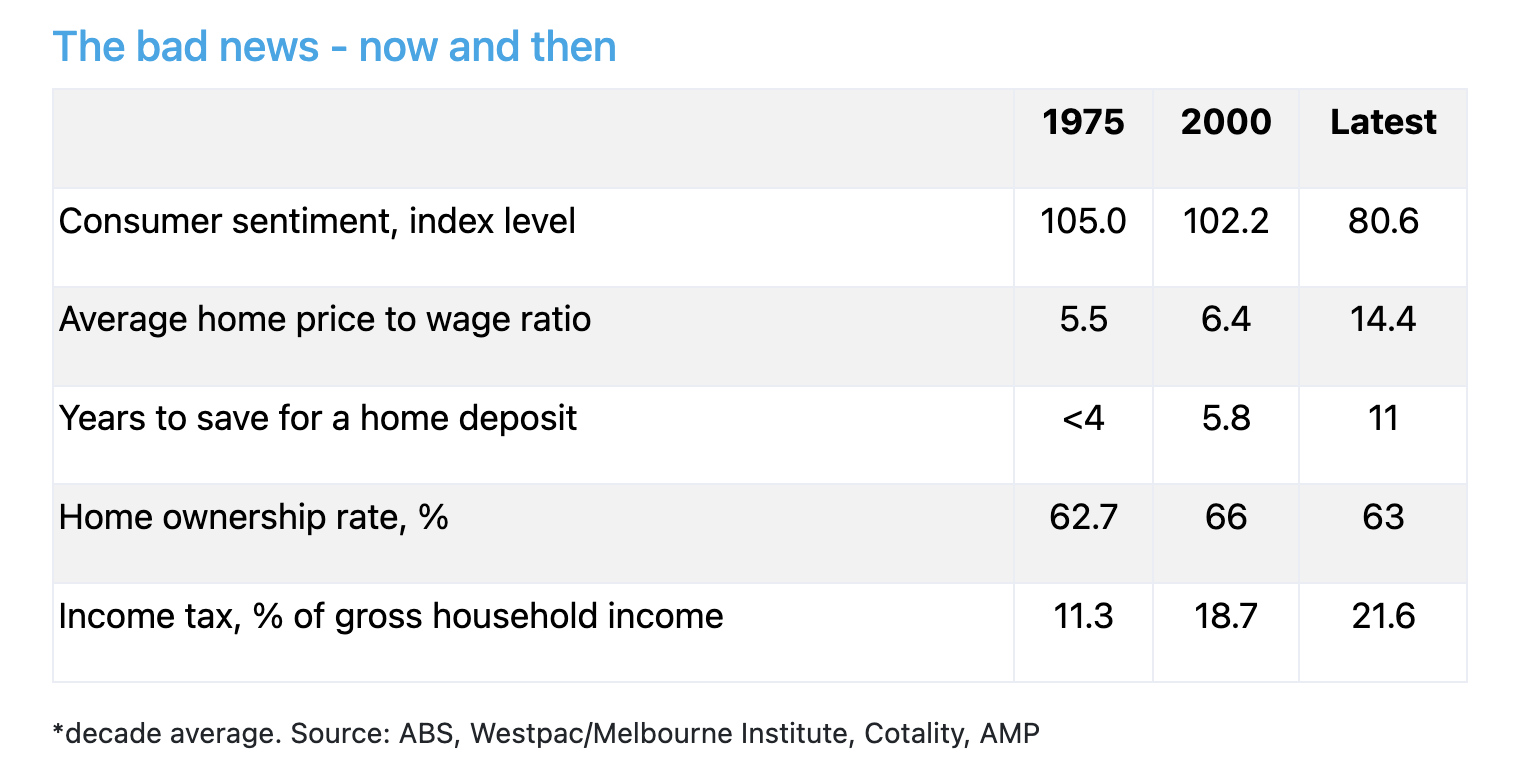
The table below provides a brief comparison of economic indicators where conditions were better 25 and 50 years ago. These periods were chosen because the 1970s broadly coincided with baby boomers entering the workforce, while Millennials entered in the 2000s and Gen Z in the 2020s.

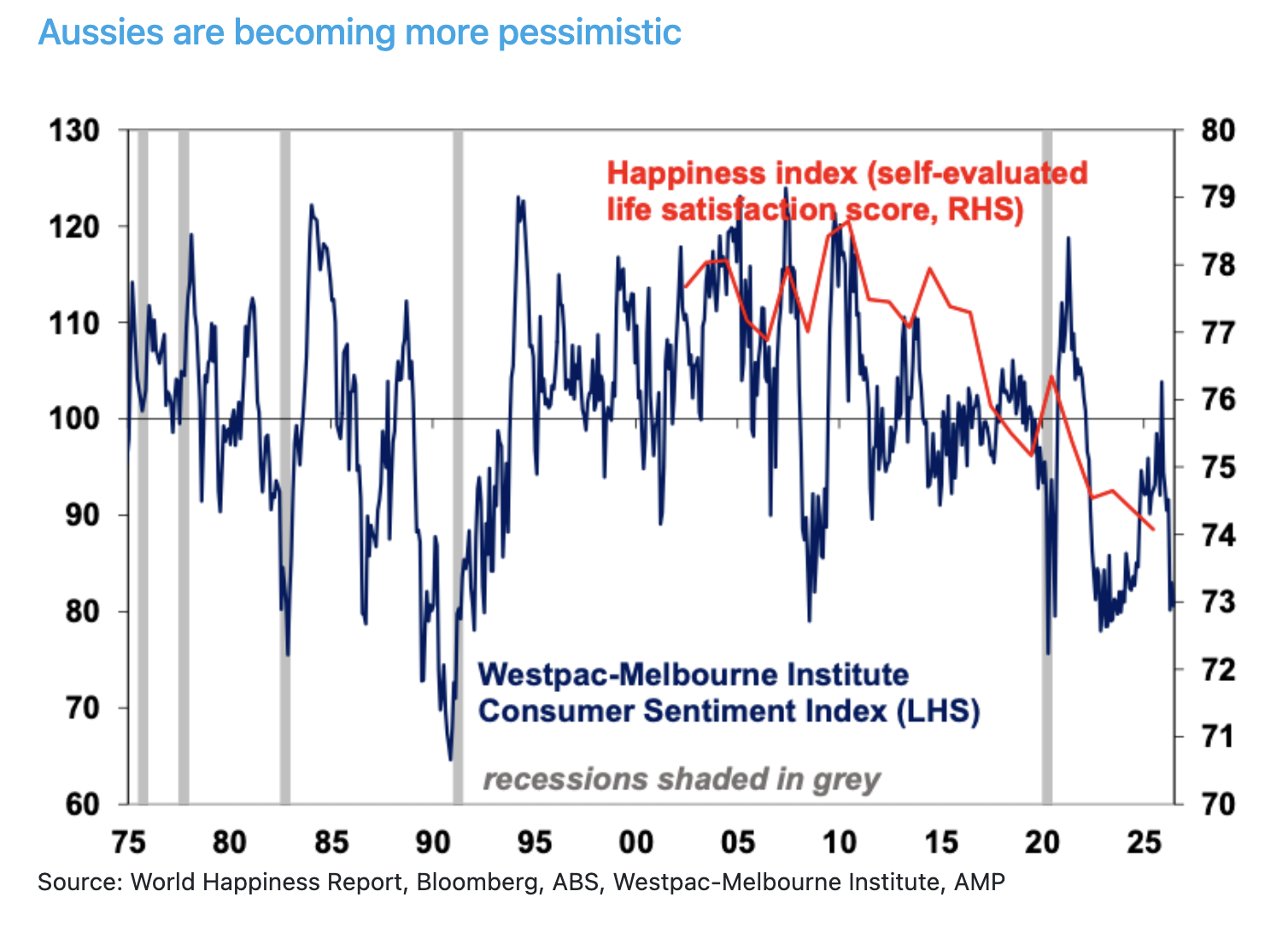
The bad news is that consumer sentiment seems to be stuck around much lower levels, despite the absence of really high unemployment as seen in the recessions of the 1980s and 1990s. And associated with this over the last 20 years happiness has been trending down. From the next chart it can be seen that the trend in both has been down since around 2015, not just the last few years.

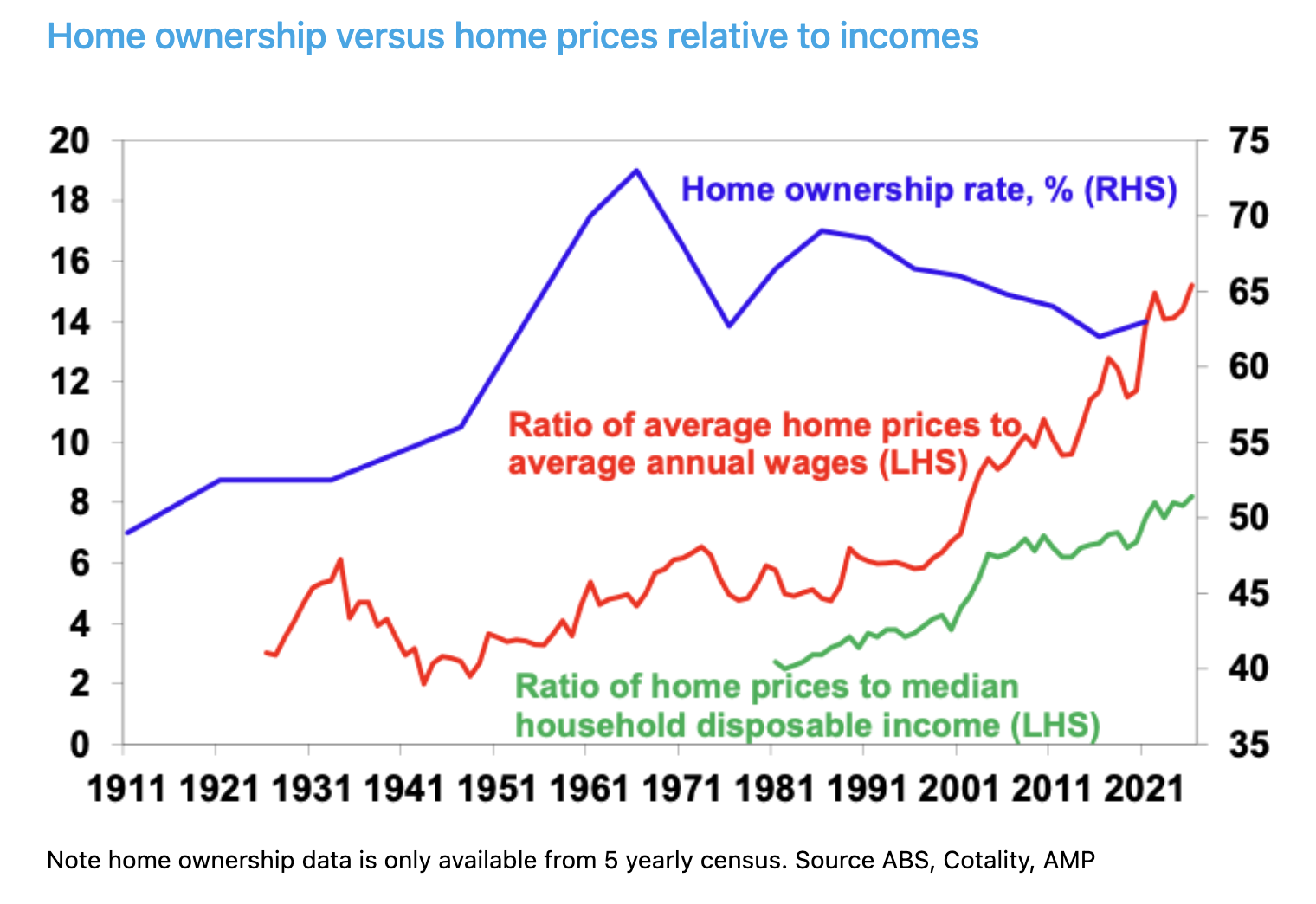
We also paid less tax as a share of our income back then. But housing is the big one – today the ratio of home prices to incomes is way above what it was 25 and 50 years ago, and it takes far longer to save for a deposit. Associated with this has been a down trend in the home ownership rate since it’s mid-1960s peak. And this arguably goes a big way to explain why younger generations may be feeling less happy today as getting a home is seen as too hard.

Of course, in the past things were also less regulated so we may have felt freer, there was a greater sense of community, there was less choice (i.e. four TV channels in the 1960s and 70s versus lots of streaming and TV options now), so less decisions to make, which resulted in less pressure. And there was no social media to bully us, rile us up or create a perpetual sense of FOMO (and in many cases relieve us of our money – though small town gossip was probably worse back then!).

But many economic indicators are far better now

Against this, virtually all other economic indicators are much better today.

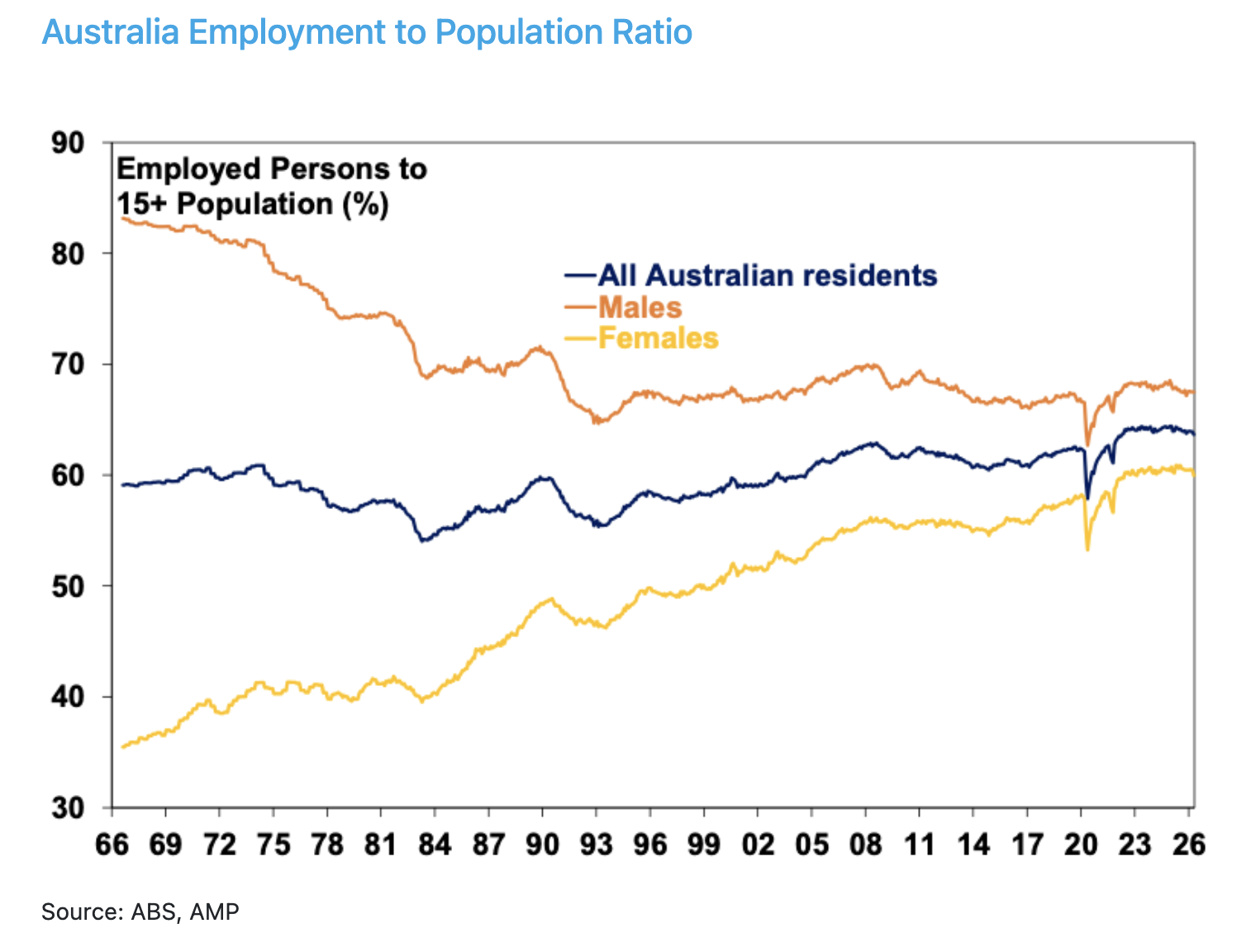
In recent decades the economic cycle has been milder with less severe recessions, generally lower unemployment and generally lower inflation. Today we are far better off materially: real household income is double what it was 50 years ago, there is a greater share of the population in employment (~64% versus 60% in the 70s, reflecting more jobs), and the female participation in the workforce has risen (helped by better education, childcare and attitudes).

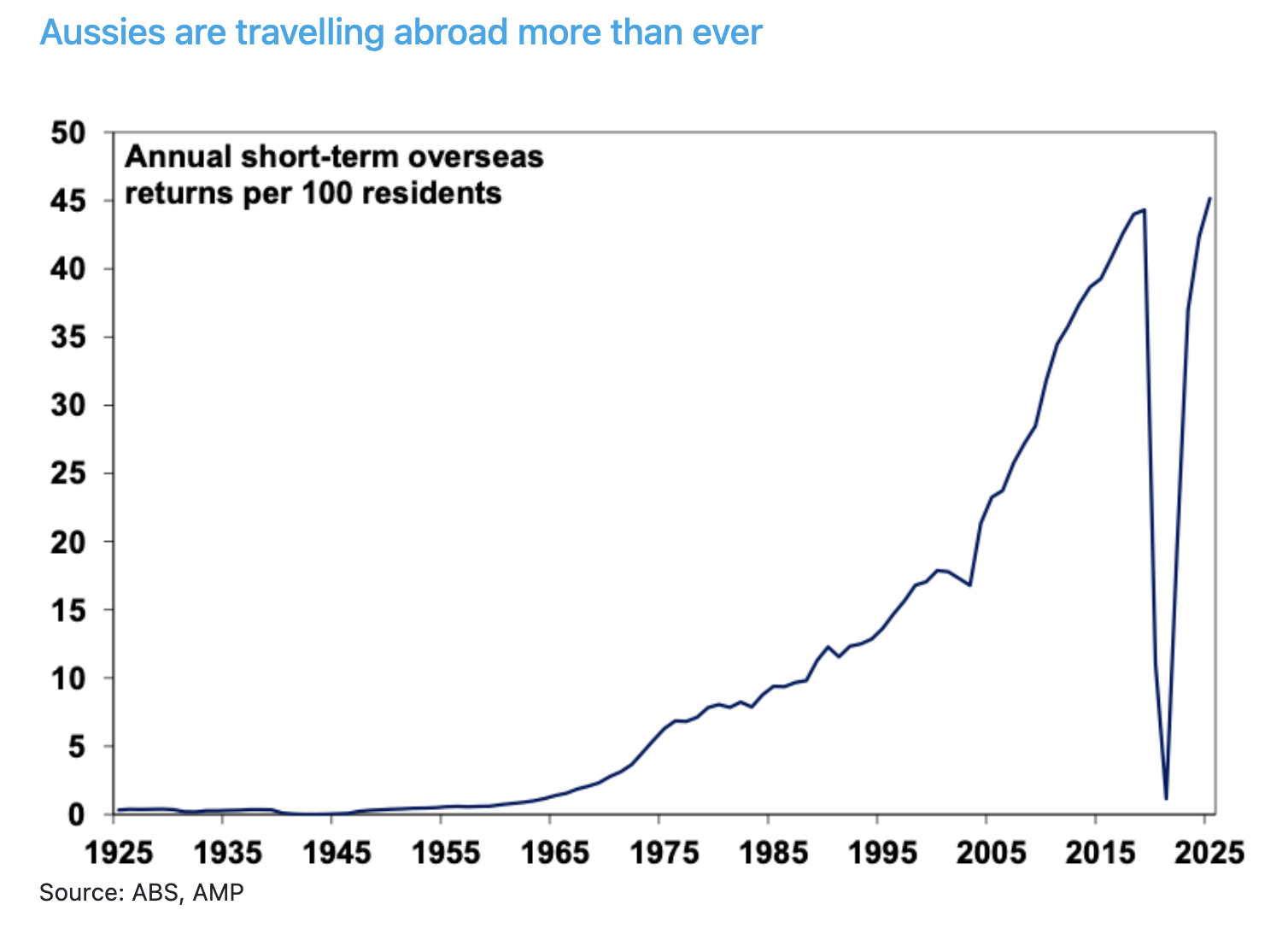
With this wealth has come more discretionary spending power to devote to things like overseas holidays – 50 years ago, an average Australian had an overseas holiday once every 16 years, now it’s just a bit less than once every two years. And more gadgets like cars – where there is now nearly one for every two people – and household appliances like huge flatscreen TVs. And multiple cafes per suburb with endless choice of coffee and food compared to the burgers and instant coffee of a few generations ago.

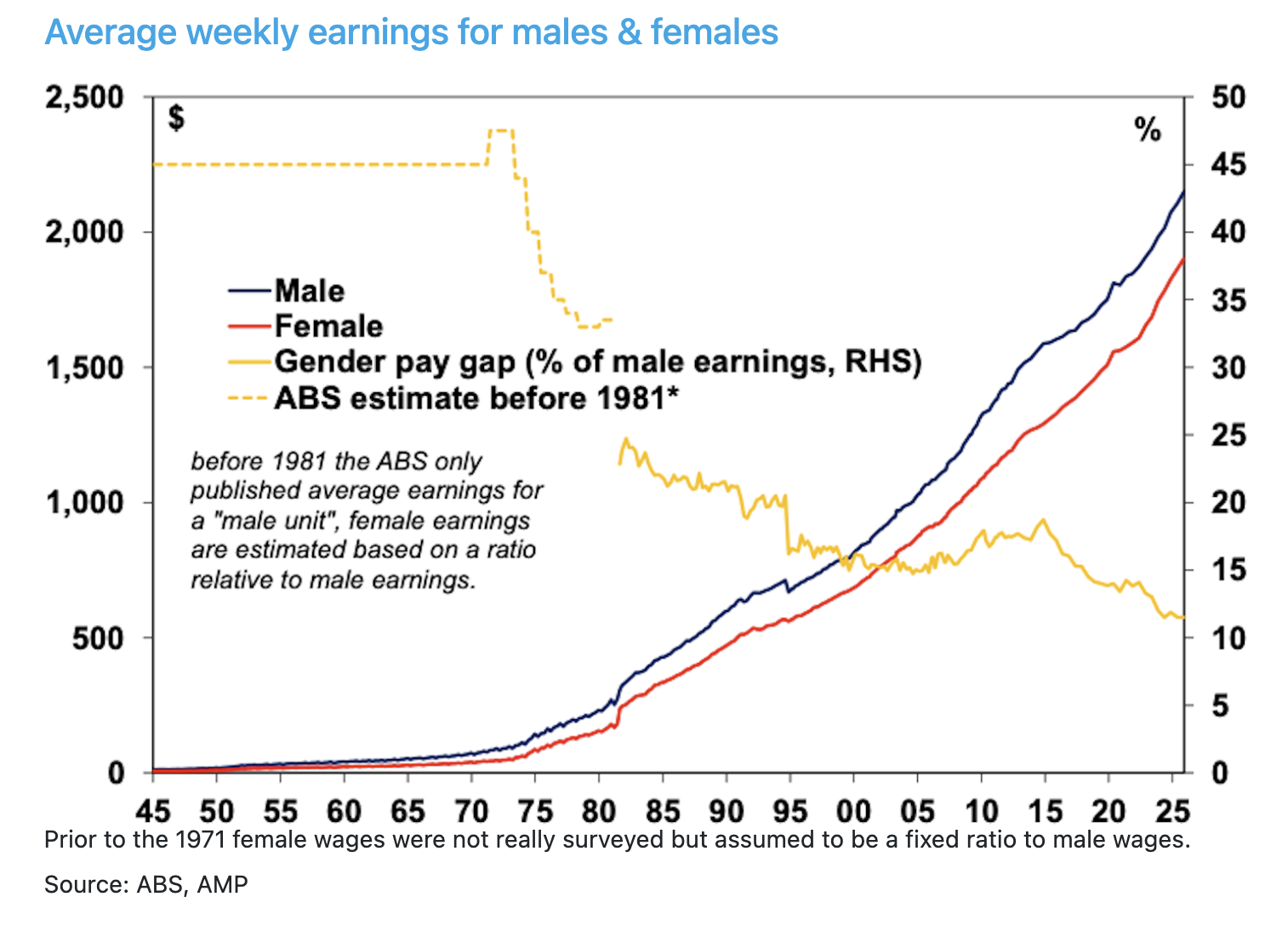
But it’s also a far more equitable society. For example, female participation in the workforce has surged from being way below that of men, more girls now go on to a university education than boys and the gender pay gap has fallen sharply (albeit there is still a way to go). It’s hard to look back a generation or two ago and say things were great when opportunities for half the population (i.e. women) were way below those of the other half. At this point we hear the manosphere crowd saying how guys are now discriminated against…and think come on guys “get a grip”! – don’t you realise that manosphere influencers are just telling you what you want to hear so they can get a buck out of you!

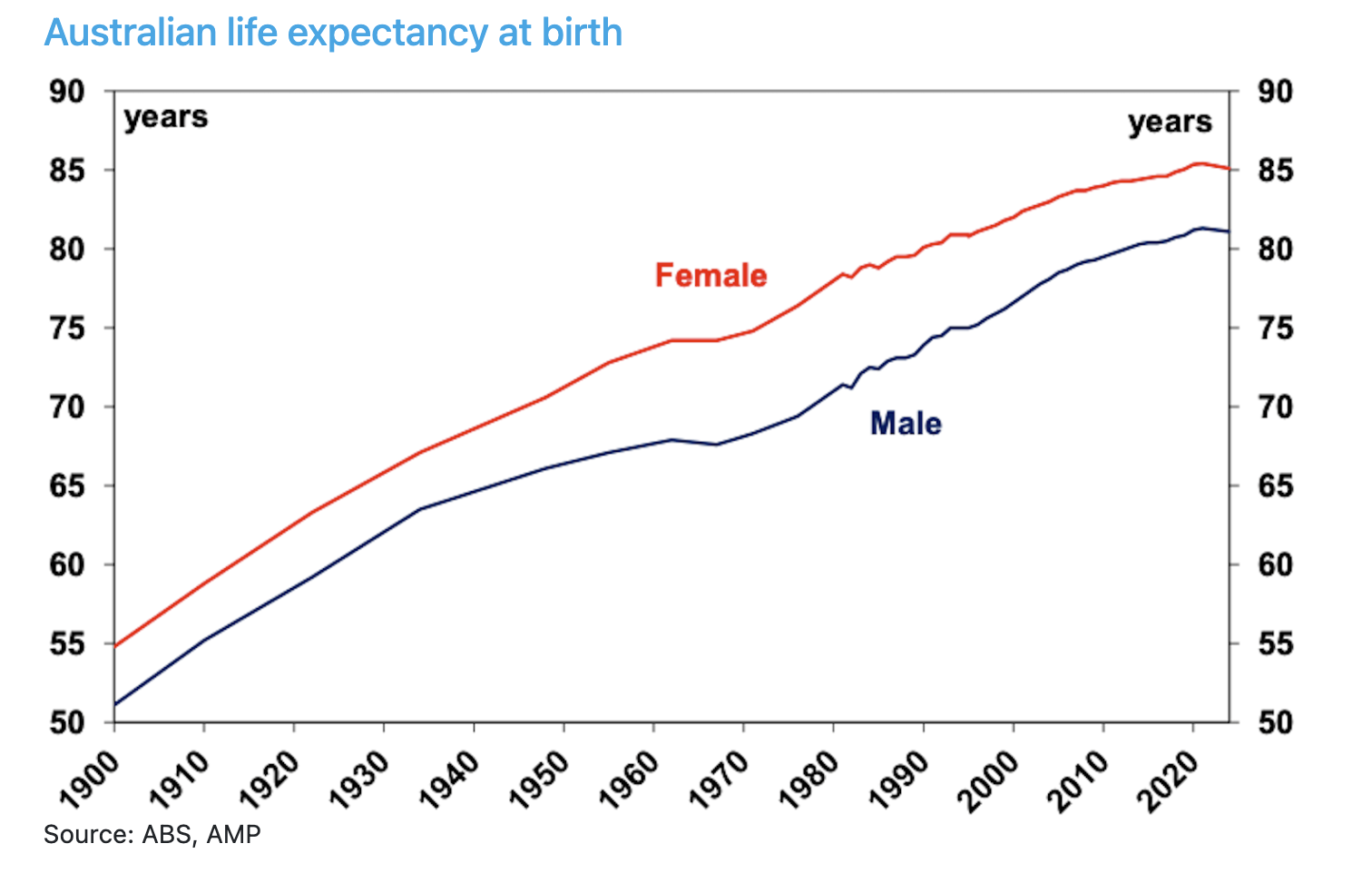
And with this surge in income and wealth has come huge medical advances which means we are living longer, active lives. (Of course, this is not to say there are not issues with obesity and too much sugar which may be starting to take a toll in the last few years!)

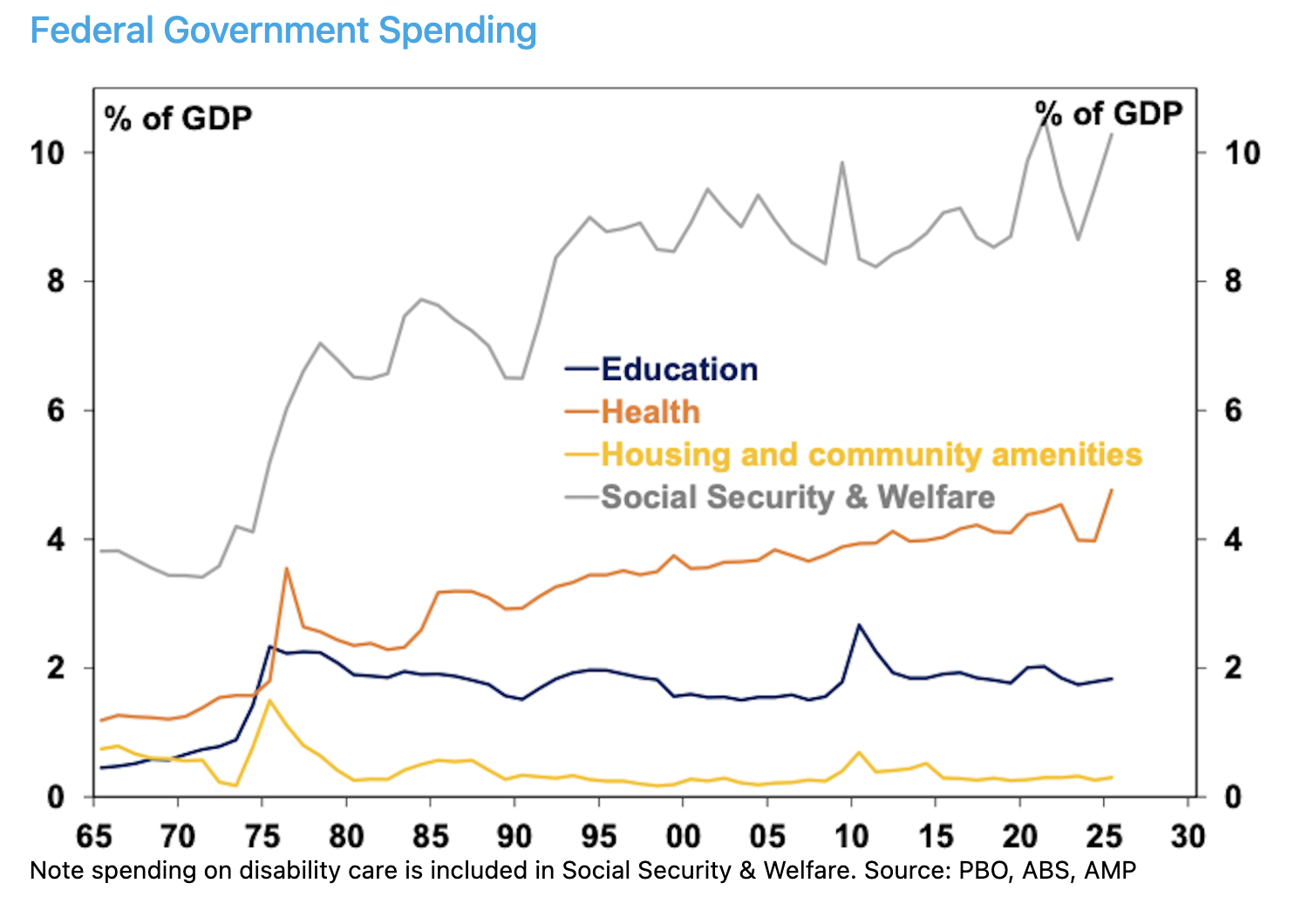
While we pay more taxes as a share of income, and more is demanded of Government, the social safety net is bigger than ever. It’s seen explosive growth in the provision of spending on welfare, health, aged and disability care – which have each more than doubled as a share of GDP. And Government is mostly doing a good job of protecting us from ourselves and each other, with for instance, a collapse in road death and homicide rates.

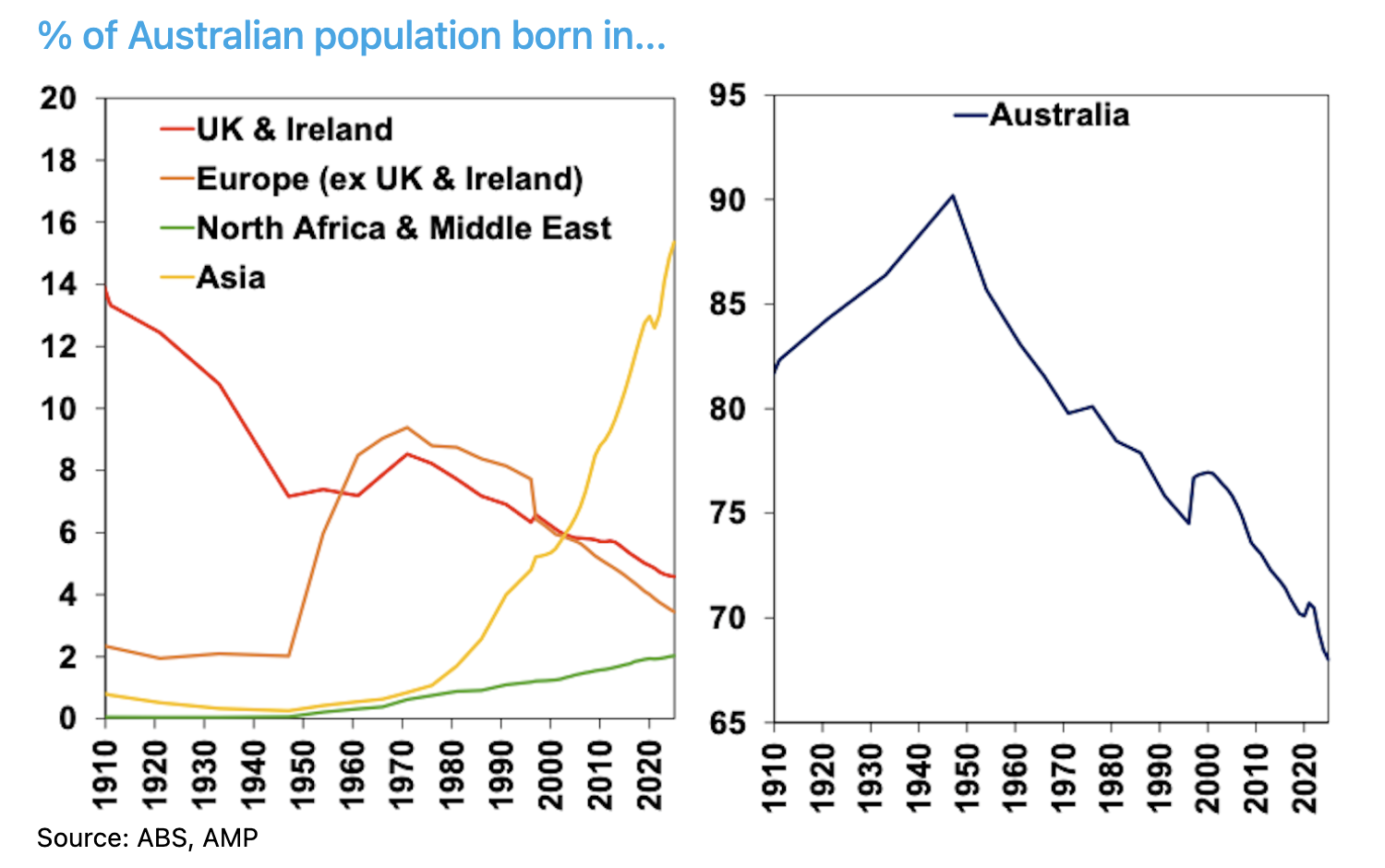
Australia is now also a far more diverse country with far more born overseas and less of those that are from a UK/European background. This has led to a richer society (e.g. more restaurants to choose from), a more innovative society and relief from the pressures of an aging population and labour shortages.

Of course, immigration is once again a hot topic – it has been periodically for as long as I can remember – but for most this seems to reflect a concern about poor housing affordability.

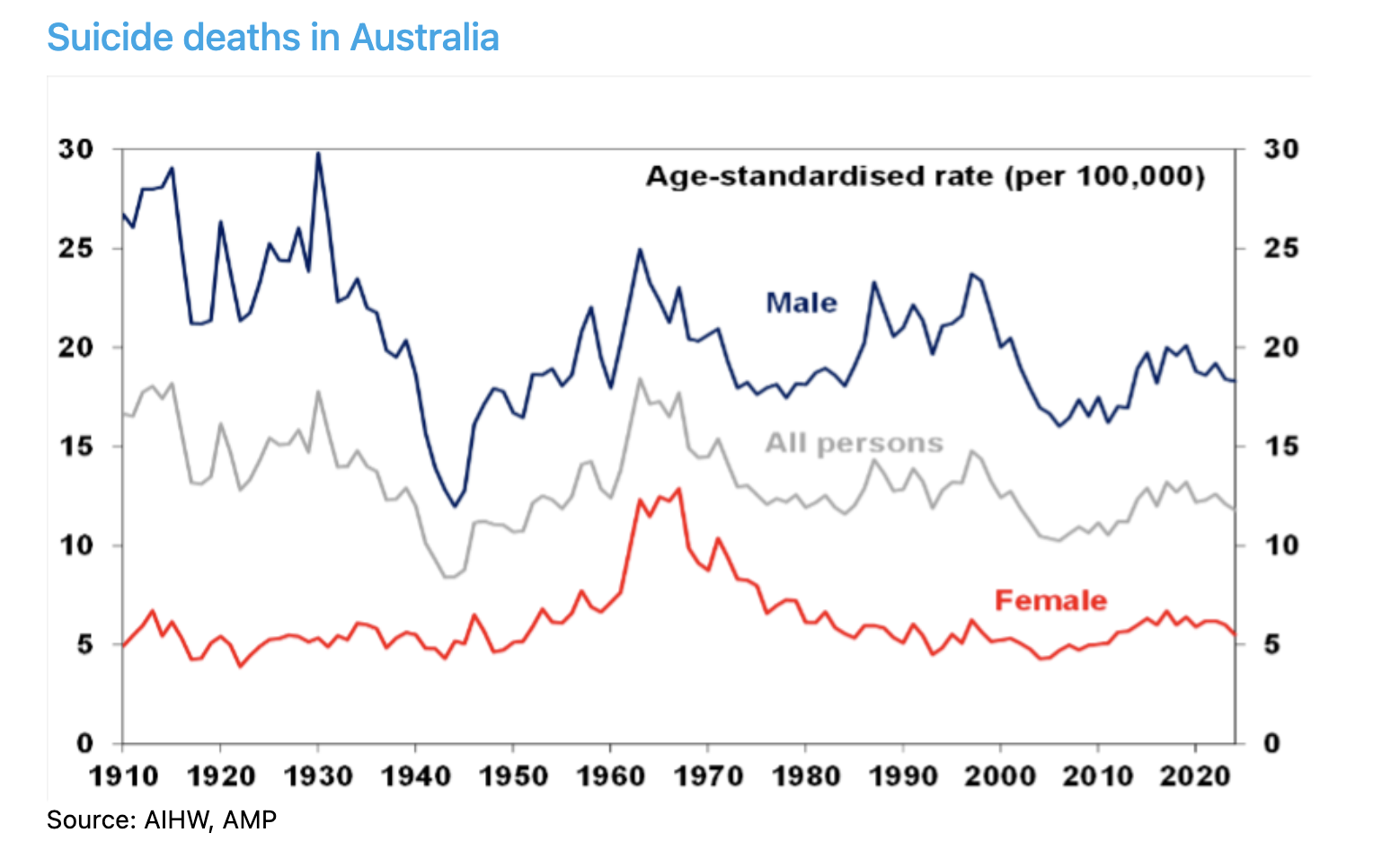
And finally, despite all the talk to the contrary, it’s still too high but the suicide rate is around where it was 25 and 50 years ago and is in fact below its level in the pre-WW2 years, the 1960s and the late 1980-90s.

So why do people still feel miserable even with all these economic achievements?

Simply because most people nowadays weren’t around back then! Around 65% of the population was born after 1975, and 78% were either not born or too young in the 1970s to remember it clearly, so much of the hardship discussed in this note sits outside most people’s lived experience. And recency bias means that even for those who were around “back then”, the tougher times they might have had can be hard to recall after three decades of economic growth and virtually no recessions in Australia.

Recency bias and higher baseline expectations also make comparisons with 25 or 50 years ago less meaningful. At the same time, things have indeed gotten a bit worse in the last 5 years.

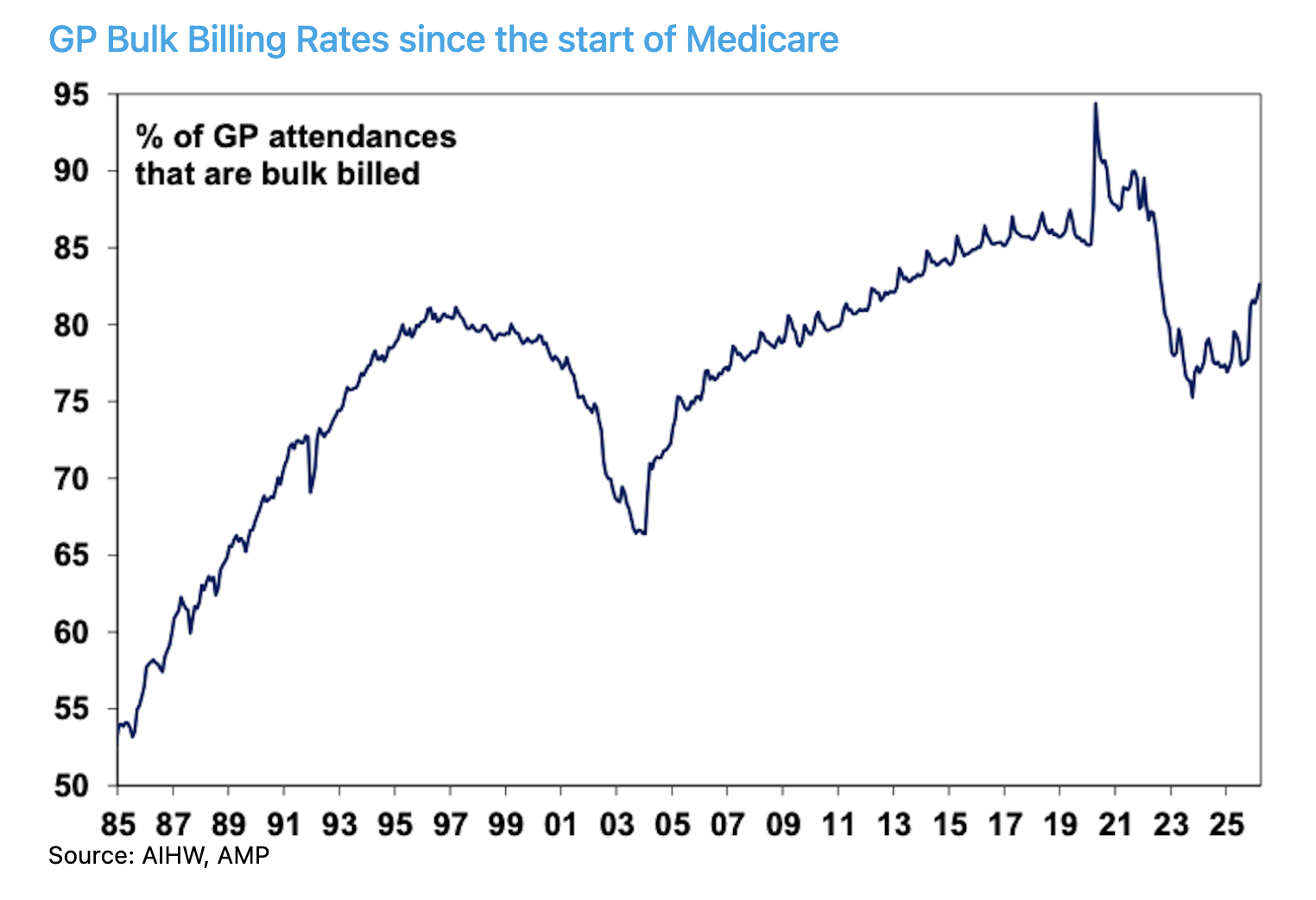
For example, health outcomes have improved over the long term, helped by medical advances, increased government health spending and better access to health care with e.g. higher bulk billing rates. But bulk billing fell sharply from 2022 until late last year as medical goods and services costs rose, with some surveys suggesting many people delayed medical appointments because of affordability. That marks a clear regression from 2020-2022, when the average bulk billing rate was 89%.

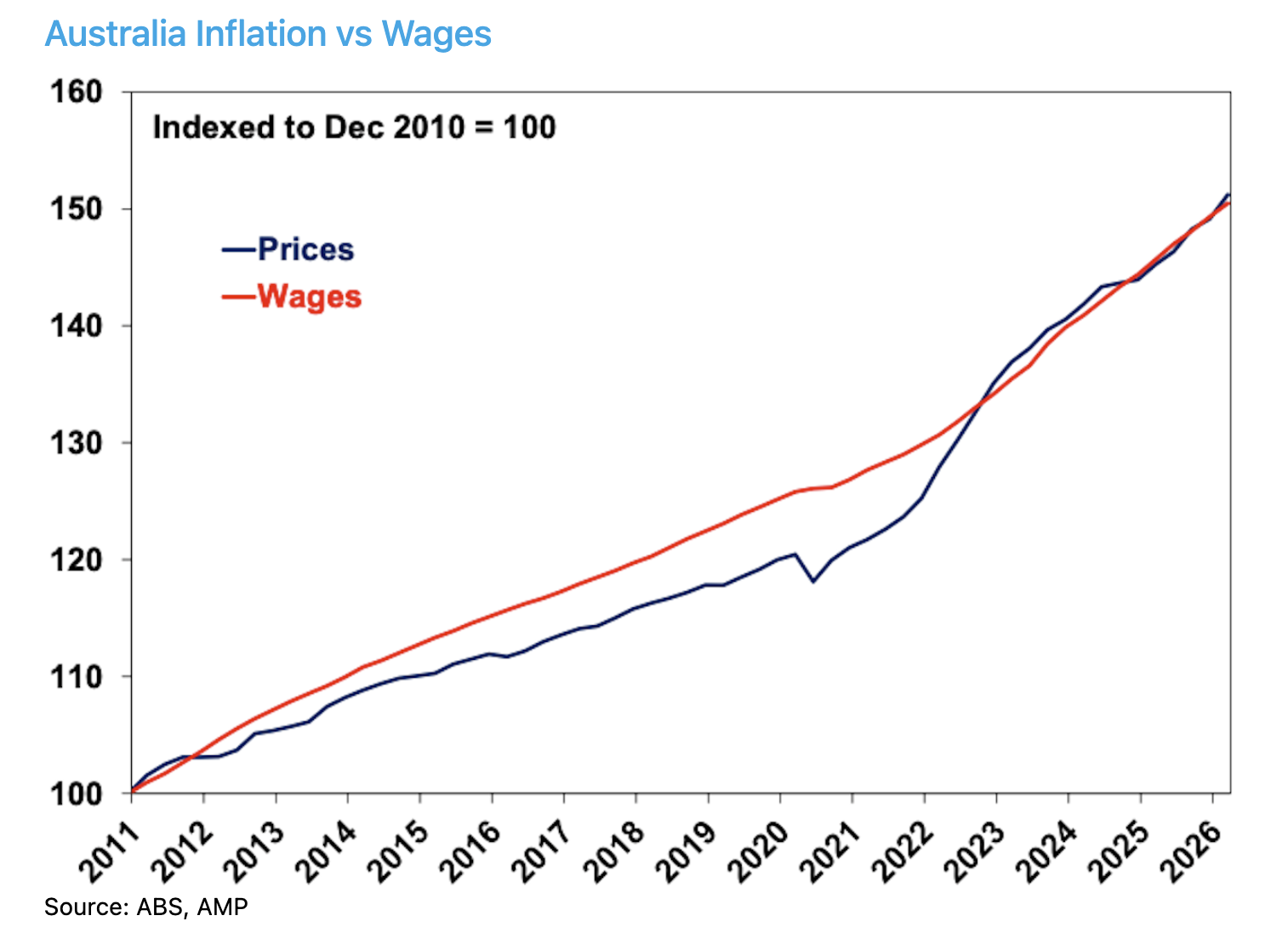
In addition, real wages have gone up significantly over the last 25 and 50 years, but the average wage earner (if they have not upskilled or changed jobs) has seen their pay lag inflation since 2021.

The root core of this is low productivity growth. Coincidentally, the structural decline in happiness in 2015 started around the same time productivity started stagnating.

Concluding comments

None of this analysis is to deny that many are struggling with “cost of living” issues and that there is a wider malaise of dissatisfaction. Government’ need to do more to boost productivity and hence grow living standards and avoid the delusion that the answer is even more government. But we suspect a big part of the problem is poor housing affordability which leads to a growing wealth gap between the haves and the have nots – fix that with a fundamental rebalancing of underlying housing supply and demand, and a lot of the angst will likely fade. This likely involves getting the balance right on immigration but not slashing it such that it just leads to labour shortages and the economy struggling with an aging population.

Finally, we need to recognise that part of the malaise associated with poor happiness and confidence reflects a problem of success. The rise in affluence has led to higher expectations than the economy can at times deliver upon. And social media – itself a product of technological success – may be contributing to the malaise via its focus on grievance and quick hits. Finding better ways to live with this success – and recognise more “things” won’t necessarily make us happier – is probably key.

Dr Shane Oliver – Head of Investment Strategy and Chief Economist, AMP

Important note: While every care has been taken in the preparation of this document, neither National Mutual Funds Management Ltd (ABN 32 006 787 720, AFSL 234652) (NMFM), AMP Limited ABN 49 079 354 519 nor any other member of the AMP Group (AMP) makes any representations or warranties as to the accuracy or completeness of any statement in it including, without limitation, any forecasts. Past performance is not a reliable indicator of future performance. This document has been prepared for the purpose of providing general information, without taking account of any particular investor’s objectives, financial situation or needs. An investor should, before making any investment decisions, consider the appropriateness of the information in this document, and seek professional advice, having regard to the investor’s objectives, financial situation and needs. This document is solely for the use of the party to whom it is provided. This document is not intended for distribution or use in any jurisdiction where it would be contrary to applicable laws, regulations or directives and does not constitute a recommendation, offer, solicitation or invitation to invest.

Integrity One Wealth Advisers  Pty Ltd

Phone : (03) 9723 0522
Email : integrity@iplan.com.au
Web : www.integrityclients.com.au
Fax : (03) 9724 9518

Facebook :
Integrity One Wealth Advisers
Integrity Edge

Address:
Suite 2, 1 Railway Crescent
Croydon, Victoria 3136

Mail:
PO Box 1140 Croydon
Victoria 3136

Note :
If you live in the South Eastern or Bayside suburbs please contact our local advisor on (03) 9723 0522.

This information is of a general nature and does not take into consideration anyone’s individual circumstances or objectives. Financial Planning activities only are provided by Integrity One Wealth Advisers Pty Ltd (ABN 35 994 727 125) as a Corporate Authorised Representative (1316489) of Integrity Financial Planners Pty Ltd (AFSL 225051). Integrity One Wealth Advisers Pty Ltd and Integrity One Accounting and Business Advisory Services Pty Ltd are not liable for any financial loss resulting from decisions made based on this information. Please consult your adviser, finance specialist, broker, and/or accountant before making decisions using this information.


Filed Under: Blogs, News Tagged With: FP

Market movements & economic review – June 2026

June 15, 2026

Stay up to date with what’s happened in the Australian economy and markets over the past month.

May delivered mixed signals for the Australian economy with inflation easing slightly, although underlying inflation edged marginally higher.

The softer-than-expected inflation data reduced expectations of further rate hikes in the near term.

Australian share markets were volatile. The ASX 200 moved within a relatively narrow range through the month, slipping slightly overall despite periods of strength linked to resources and AI‑related stocks.

Globally, markets continued to be shaped by Middle East tensions and ongoing inflation concerns. US markets made some big gains with the S&P 500 hitting an all-time high in the final days of May, up by just over 28% year-on-year.

Click here to view our update.

Please get in touch  if you’d like assistance with your personal financial situation.

Integrity One Wealth Advisers  Pty Ltd

Phone : (03) 9723 0522
Email : integrity@iplan.com.au
Web : www.integrityclients.com.au
Fax : (03) 9724 9518

Facebook :
Integrity One Wealth Advisers
Integrity Edge

Address:
Suite 2, 1 Railway Crescent
Croydon, Victoria 3136

Mail:
PO Box 1140 Croydon
Victoria 3136

Note :
If you live in the South Eastern or Bayside suburbs please contact our local advisor on (03) 9723 0522.

This information is of a general nature and does not take into consideration anyone’s individual circumstances or objectives. Financial Planning activities only are provided by Integrity One Wealth Advisers Pty Ltd (ABN 35 994 727 125) as a Corporate Authorised Representative (1316489) of Integrity Financial Planners Pty Ltd (AFSL 225051). Integrity One Wealth Advisers Pty Ltd and Integrity One Accounting and Business Advisory Services Pty Ltd are not liable for any financial loss resulting from decisions made based on this information. Please consult your adviser, finance specialist, broker, and/or accountant before making decisions using this information.

Filed Under: Blogs, News Tagged With: FP

Get prepared for June 30

June 15, 2026

Tax time is just around the corner, so now is the time to get ahead and find out what strategies may be available to you before 30 June.

Time for a portfolio review

A good first step is to review your investment strategy. With recent market volatility, things may have shifted and your risk tolerance may have changed considerably.

It’s also worthwhile checking your capital gains or losses before 30 June, as this allows you to take action where appropriate.

For example, you may consider realising capital losses to offset gains from assets such as shares, property or crypto.

Super contribution strategies

You should also check your super contributions as early as possible. If you have not reached the Super Guarantee (SG) contributions cap of $30,000, or $120,000 for non-concessional contributions, you may be eligible to make additional contributions to your super.

If you plan to contribute before 30 June, check when your employer will make their contributions. The introduction of Payday Super means some employers are contributing earlier, which may affect your contribution caps.

You will also need to find out the cut-off date from your super fund, which is generally 25-26 June.

There are various ways that you can boost your super, which include:

  • Salary sacrifice
    Although your employer makes compulsory contributions, you can also make concessional (before-tax) contributions using a salary sacrifice arrangement. Not all employers offer these arrangements and there are eligibility requirements to meet.
  • Personal deductible contributions
    You may be eligible to claim a tax deduction for personal contributions, if you have spare cash available. This strategy works well late in the financial year when your tax position is clearer.
  • Catch-up contributions
    Unused concessional caps from the past five years may be available, subject to eligibility rules including your total super balance.
  • Non-concessional contributions
    Non-concessional contributions, made from your savings or after-tax pay, can help boost your super and allow larger amounts to be invested.
  • Government co-contribution
    Low-to-middle income earners making after-tax contributions before 30 June may be eligible to receive up to $500 from the government as a co-contribution into their super account. Eligibility rules apply.
  • Spouse contribution tax offset
    If your spouse earns less than $40,000, you may be eligible for a tax offset of up to $540 by contributing to their super.

For SMSF members, make sure that:

  • All contributions are received by the fund’s bank account by 30 June
  • Minimum pension payments are made
  • Asset valuations are up to date
  • Fund records are current

Division 296 super tax

It’s also important to note that Division 296 tax comes into effect on 1 July 2026 and applies to investment earnings earned during 2026–27 and the following financial years.

For those whose total super balance exceeds $3 million on 30 June 2027 there will be a 15 per cent additional tax on the proportion of earnings corresponding to the Total Super Balance (TSB) between $3 million and $10 million and an additional 25 per cent tax on the proportion of earnings corresponding to TSBs above $10 million.

Tax timing strategies

If you have regular deductible expenses, such as investment loan interest or annual costs, it may be useful for some to prepay them before 30 June to claim a deduction for this financial year.

You may also consider the timing of income expected before 30 June. Deferring income until after the end of the financial year may help reduce your tax liability.

Tax rates are also changing for lower income earners. From 1 July 2026, the rate for income between $18,201 and $45,000 will reduce from 16 per cent to 15 per cent, with a further reduction to 14 per cent the following year.

Tax returns done right

While planning ahead for the EOFY is key, it’s also important to take the time to understand what the ATO is focusing on when it comes to preparing your tax return post June 30.

This year, the ATO will be focusing on work-related deductions and income that’s not declared on tax returns.

If you are claiming work-related expenses, ensure they meet the ATO’s three golden rules:

  • The expense must be directly related to earning your income
  • You must not have been reimbursed
  • You must have records to support your claim, such as receipts or a logbook.

If you work from home for all or part of the week, you can use either the actual cost method or the fixed rate method.

Don’t overlook income

The ATO is also paying close attention to undeclared income. This includes:

  • Cash payments
  • Interest income
  • Rental income
  • Earnings from crypto assets.

For those with a side hustle, check whether it may be considered a business. All business income, regardless of amount, is assessable and must be declared.

If you intend to claim deductions for business expenses related to your side hustle, ensure they are directly connected to earning that income and are supported by receipts. Your accountant will be able to determine what should be declared.

If you’d like to talk to us about ways to boost your super before EOFY or questions about your investment strategies, call today to ensure everything is in place before 30 June.

Source: https://www.ato.gov.au

Integrity One Wealth Advisers  Pty Ltd

Phone : (03) 9723 0522
Email : integrity@iplan.com.au
Web : www.integrityclients.com.au
Fax : (03) 9724 9518

Facebook :
Integrity One Wealth Advisers
Integrity Edge

Address:
Suite 2, 1 Railway Crescent
Croydon, Victoria 3136

Mail:
PO Box 1140 Croydon
Victoria 3136

Note :
If you live in the South Eastern or Bayside suburbs please contact our local advisor on (03) 9723 0522.

This information is of a general nature and does not take into consideration anyone’s individual circumstances or objectives. Financial Planning activities only are provided by Integrity One Wealth Advisers Pty Ltd (ABN 35 994 727 125) as a Corporate Authorised Representative (1316489) of Integrity Financial Planners Pty Ltd (AFSL 225051). Integrity One Wealth Advisers Pty Ltd and Integrity One Accounting and Business Advisory Services Pty Ltd are not liable for any financial loss resulting from decisions made based on this information. Please consult your adviser, finance specialist, broker, and/or accountant before making decisions using this information.

Filed Under: Blogs, News Tagged With: FP

2026 – 2027 Federal Budget

May 13, 2026

Reform and resilience in uncertain times

Treasurer Jim Chalmers has framed the 2026 Federal Budget as “the most important and ambitious budget in decades”.

“This Budget is about getting us through the global oil shock and taking pressure off Australians while building a stronger economy, better tax system, a more sustainable budget and lifting living standards,” the Treasurer told Parliament.

With an overarching theme of ‘reform and resilience’, the Federal Government is aiming to shore up investor confidence at a time when the global economy teeters thanks to war in the Middle East and the disruption of global oil supplies. Despite the challenges, Treasury says Australia’s economy continues to grow faster than every major advanced economy.

For households and wage earners, the Budget delivers a mix of targeted cost-of-living relief and significant structural reform, particularly in tax and housing.

The big picture

At the headline level, the Budget forecasts an underlying cash deficit of $31.5 billion in 2026–27, an improvement of $2.8 billion on the mid‑year update, despite slower global growth and higher oil prices.

Economic growth is forecast to slow from 2.25 per cent this financial year to 1.75 per cent in 2026–27, reflecting weaker international conditions, before gradually strengthening over the medium term. Inflation is expected to rise temporarily in the June quarter to around 5 per cent driven largely by fuel and transport costs linked to the war‑driven global oil shock. Despite this near-term pressure, the Government continues to project a return to a balanced budget in the mid-2030s followed by modest surpluses.

The Treasurer maintains that budget repair is being driven primarily by savings and spending restraint, rather than broad-based tax increases.

From a policy perspective, the Budget rests on five pillars: managing the global oil shock; easing cost‑of‑living pressures; lifting productivity; reforming the tax system; and strengthening national resilience. Each has direct implications for household finances, superannuation, investment structures and long‑term planning.

The Treasurer has made clear that a major goal is to “rebalance the tax system” so that wage earners are not treated substantially differently from those who earn income through assets and investments.

While some measures will take years to flow through, the direction is to prioritise the national security, energy supply, productivity and care sectors, while accepting political risk, to strengthen the economy over the medium to long term.

Cost-of-living

The Government has been careful to structure cost-of-living measures so that they don’t meaningfully add to inflation. The most prominent initiative is the Working Australians Tax Offset, providing a $250 offset for more than 13 million employees from the 2027–28 income year.

In addition, workers will be able to claim a $1,000 instant tax deduction for work-related expenses from 2026–27, without the need to keep receipts.

Income tax thresholds will also be adjusted. From 1 July 2026, the 16 per cent tax rate, applying to income between $18,201 and $45,000, will be reduced to 15 per cent before falling further to 14 per cent from 1 July 2027.

The government will increase Medicare Levy low-income thresholds by 2.9 per cent from the 2025–26 income year, a change expected to benefit more than one million lower-income Australians who will remain exempt from the Levy or pay a reduced rate.

Productivity

Productivity comes in for renewed focus, reflecting concern that long-term improvements in living standards can’t be sustained without structural change. The Budget allocates funding aimed at reducing red tape by an estimated $10.2 billion per year, including faster environmental approvals and streamlined foreign investment processes.

Housing construction remains a central productivity priority. New funding for local infrastructure is designed to support up to 65,000 extra homes, alongside measures to fast‑track skilled migrant trades and improve construction capacity.

Investment in transport infrastructure also features prominently, with $8.6 billion committed to nationally significant road and rail projects, improving freight efficiency and workforce mobility particularly across the regions.

Taken together, these measures represent a shift toward capability building. For business owners and investors, the emphasis is on reducing friction, improving labour supply and supporting capital investment that lifts output over time rather than fuelling higher prices.

Tax reform

The most debated element of the Budget is the tax reform package directed at property investors and discretionary trusts.

From 1 July 2027, negative gearing will be limited to new housing, with existing arrangements grandfathered. At the same time, the 50 per cent capital gains tax (CGT) discount will be replaced with cost-base indexation, alongside a new minimum effective tax rate of 30 per cent on capital gains.

The CGT settings for super and self-managed super funds will remain unchanged, which means investors will continue to receive a CGT discount of 33.33 per cent for relevant assets held for over 12 months in super.

The Government argues these changes are essential to address intergenerational inequity and housing affordability, while continuing to support investors who add to new housing supply. Treasury modelling suggests a modest impact on rents over time, with savings redirected toward care services and tax relief for wage earners.

Trusts have also been brought into the Government’s tax reform agenda, with a new minimum 30 per cent tax rate to apply to discretionary trust distributions from 1 July 2028. The measure is aimed at improving integrity and reducing income‑splitting arrangements that allow some taxpayers to pay significantly less tax than wage earners on comparable incomes.

Housing affordability

The Treasurer aims to address housing shortages and affordability, by increasing total investment to $47 billion and supporting an estimated 75,000 additional Australians to achieve home ownership over the next decade through the tax reform package.

The Government claims around 65,000 additional homes will be delivered over 10 years through its support for new developments. A new $2 billion fund has been established to help local governments and state utilities build the infrastructure needed to support new housing.

To free up additional supply, the Government is extending the ban on foreign buyers purchasing established homes until mid-2029.

Aged care and health

Health and aged care receive significant additional funding as demand continues to rise. The Budget commits $25 billion in additional hospital funding over the medium term, alongside incentives to expand bulk billing and reduce strain on emergency departments.

The Government has confirmed further reductions in the cost of medicines, building on earlier PBS reforms, with cheaper scripts and faster access to newly listed drugs funded through additional PBS investment.

Aged care reform focuses on both supply and workforce sustainability. The Government will fund incentives to support construction of an additional 5,000 residential aged care beds per year by 2029.

The NDIS also features prominently, with continued efforts to rein in unsustainable cost growth and strengthen integrity. Measures include tightening eligibility, reducing rorting and redirecting funding towards participants with the highest needs.

Future proofing

The focus on national resilience is a defining characteristic of the Budget. Fuel security is front and centre following the global oil shock, with measures to secure domestic fuel reserves, reserve 20 per cent of gas exports for Australian use and provide concessional finance to logistics and manufacturing firms most exposed to price volatility.

Defence spending also rises sharply, with a record additional $53 billion committed over the coming decade. The focus is on readiness, supply chains and regional security, reflecting growing geopolitical risk in the Indo‑Pacific and beyond.

Looking ahead

The outlook remains uncertain. Treasury acknowledges the risk of further inflation spikes if global energy markets deteriorate, with worst-case scenarios still modelling inflation above 7 per cent and higher unemployment. But the central forecast avoids recession and assumes gradual improvement from late 2027 onward.

Information in this article has been sourced from the Budget Speech 2026-27 and Federal Budget Support documents.  

It is important to note that the policies outlined in this article are yet to be passed as legislation and therefore may be subject to change. 

If you have any questions about how the 2026 Federal Budget may affect your personal finances, please contact us to discuss.

Integrity One Wealth Advisers  Pty Ltd

Phone : (03) 9723 0522
Email : integrity@iplan.com.au
Web : www.integrityclients.com.au
Fax : (03) 9724 9518

Facebook :
Integrity One Wealth Advisers
Integrity Edge

Address:
Suite 2, 1 Railway Crescent
Croydon, Victoria 3136

Mail:
PO Box 1140 Croydon
Victoria 3136

Note :
If you live in the South Eastern or Bayside suburbs please contact our local advisor on (03) 9723 0522.

This information is of a general nature and does not take into consideration anyone’s individual circumstances or objectives. Financial Planning activities only are provided by Integrity One Wealth Advisers Pty Ltd (ABN 35 994 727 125) as a Corporate Authorised Representative (1316489) of Integrity Financial Planners Pty Ltd (AFSL 225051). Integrity One Wealth Advisers Pty Ltd and Integrity One Accounting and Business Advisory Services Pty Ltd are not liable for any financial loss resulting from decisions made based on this information. Please consult your adviser, finance specialist, broker, and/or accountant before making decisions using this information.
Filed Under: Blogs, News Tagged With: FP

The RBA hikes again to control inflation – lessons learned from the 1970s

May 11, 2026

  Key points

  • The RBA hiked its cash rate for the third time this year by another 0.25% to 4.35% in response to inflation running above target and concerns that it will likely remain so for longer given price pressures partly flowing from the War with Iran, threatening higher inflation expectations.
  • The key lesson from the 1970s is that the RBA is right to be focussing first on getting inflation back to target – as it will avoid even more pain down the track.
  • We are allowing for a further rate hike in August, but the longer the Strait of Hormuz remains blocked the greater the risk of recession allowing a return to rate cuts next year.
  • The best things the Government can do in the Budget to help alleviate underlying inflation pressures is to lower the level of public spending and boost productivity.

The RBA hikes to 4.35%

The RBA’s decision to hike rates to 4.35% was no surprise with it being about 75% factored in by the money market and 21 of the 22 economists surveyed by Bloomberg expecting a hike. The decision means that the RBA has now reversed all of the three rate cuts we saw last year, which followed 13 rate hikes in 2022 and 2023. Once passed on to mortgage holders it will leave mortgage rates around levels prevailing in late 2011. For a mortgage holder with an average $660 mortgage this will mean an extra $110 a month in mortgage payments or $1300 a year.

Growth down, inflation up – a whiff of stagflation

The RBA revised down its growth forecasts compared to February reflecting the impact of the War and a higher money market profile for the expected cash rate. While it revised up its unemployment forecast for 2028 it was only marginally to 4.7%. It also revised up its forecasts for trimmed mean inflation for the next year reflecting second round impacts from the War, but then sees it falling in 2027-28 back to target as higher rates and lower growth lead to lower demand and hence lower pricing.

This is a dismal outlook with growth of 1.3-1.4% for two years, a poor inflation/growth trade-off and higher unemployment. It’s a whiff of stagflation. The risk is that unemployment ends up much higher than the RBA’s 4.7% forecast.

Key reasons for the rate hike

In hiking rates again, the RBA noted an expected further boost to inflation from the War including via second round effects, at a time when inflation was already too high and increasing concern that inflation expectations will rise as a result. It is clearly more concerned at this point about inflation (where it is underperforming relative to its objective) than full employment (where it is arguably meeting its objective at least for now).

Governor Bullock’s press conference comments basically reinforced these concerns and left the door open for further interest rate hikes if needed.

The RBA also indicated it will remain “attentive to the data”. If unemployment remains lowish but underlying inflation high, then more rate hikes are likely. But if unemployment starts to rise sharply relative to inflation, then it will put a brake on RBA hikes.

With the RBA hiking and the money market still expecting another 1.5 rate hikes by year end (on top of this one), interest rates in Australia are moving higher relative to other major countries. This reflects other major countries mostly having inflation much closer to target before the War started, whereas Australia already had an inflation.

The oil supply shock makes the RBA’s job difficult

It was hoped at the time of the last RBA meeting in March that we would have more clarity around the Iran War. And a collapse in Australian petrol prices to near pre-War levels helped along by the fuel tax cuts and an easing in the immediate fuel supply fears of a month ago may be providing a sense of complacency. Unfortunately, the outlook for the War is as clear as mud. Trump wants to TACO but Iran remains intent on inflicting economic pain until the US backs down more. The Strait remains closed and Iran is responding militarily to any move by the US to prize it open without at the same time the US lifting its own blockade on Iranian shipping. So, it’s a standoff.

And the longer the Strait remains closed the greater the odds of a severe bout of stagflation – with inflation well above 5% and recession – as the full implications of the implied 10-15% hit to global oil and gas supply will become apparent as oil reserves run down.

This would mean higher oil prices (possibly up to around $US150 a barrel), and for Australia a sharp rebound in petrol prices from the recent lull and fuel rationing which will lead to a bigger boost to inflation initially and hit to economic activity. It’s not our base case – as the pressure on Trump to strike a deal with Iran (no matter how vacuous) is very high given the approaching midterm elections. But the risk rises for each day the Strait remains effectively blocked. This leaves the RBA in a difficult balancing act – should it focus on inflation or worry about the hit to growth and the risk of a much bigger rise in unemployment?

The 1970s suggests keeping inflation down is key

The experience of the 1970s holds key lessons for today. It saw inflation progressively surge into double digits in response to labour and oil shocks, rapidly rising government spending and overly easy monetary policy. Importantly, inflation had already started to rise before the first oil shock in 1973. It contributed to even higher inflation and weak growth and rising unemployment giving rise to the term stagflation. Then like now central banks grappled with whether to target inflation or weak economic activity but initially ran too easy monetary policy which allowed inflation to get out of control with surging inflation expectations which then meant that ultimately to get it under control in the 1980s (and 1990s in Australia) very tight monetary policy and deep recession were required. The key lessons were that: entrenched inflation is bad for the economy as most lose from cost of living pressures; once the inflation genie gets of the bottle it gets harder and harder to get it back in as inflation expectations rise; and that whether its initially due to a hit to supply or strong demand the central bank has to respond by tightening monetary policy and focussing initially on keeping inflation down to avoid a higher cost later.

History doesn’t repeat but it does rhyme and there are several parallels today with the 1970s – bigger government, deglobalisation, decarbonisation and aging populations have already made the economy more inflation prone and with the oil shock we are now seeing the third supply shock this decade (following the pandemic and the Ukraine War). And the Iran War threatens a further rise in underlying inflation with many reports and anecdotes of price rises for everything from airfares to toilets. Underlying inflation may also be boosted if fuel shortages lead to supply side problems. And with Australian inflation already above target and now likely to be more so the greater the risk that this will flow through to higher inflation expectations leading to higher wage demands and business being more inclined to put through bigger price rises. The longer inflation stays above target, and it now looks like doing so for five of the last six years including the present year, the more people will expect it to stay above target and the harder it will be for the RBA to get it back down. Businesses are already reporting a big rise in price pressures. This effectively blew my pre-War optimism on inflation out of the water!

So the RBA is right to be concerned and wants to show that it remains determined to get inflation back to target and to not let it spiral higher as occurred in the 1970s. This is not about thinking that higher rates can get fuel costs back down but rather is about bring demand in the economy back into line with supply and showing that its serious about: preventing a further flow on to underlying inflation; wanting to see inflation go back to target in a reasonable time frame; and trying to keep inflation expectations down.

The risk of course is that higher mortgage rates combined with War drag Australia into recession. Household spending power will be hit by a combination of the three rate hikes (which in total will cost around $300 a month in higher interest payments for those with a mortgage) and a likely rebound in petrol prices with the Strait remaining closed. Households with a mortgage are far more sensitive to changes in their disposable income than older Australians who may benefit from higher rates on their bank deposits. It’s also worth noting that the value of household debt in Australia is almost double the value of household bank deposits so higher rates cost the household sector far more than it benefits it. And fuel rationing possibly in June if the Strait remains closed will have a broader impact on the economy in curtailing some activities. Australia is particularly vulnerable on this front as we import 80-90% of our oil products.

All up and depending on how long the oil disruption lasts, in a worst case scenario the hit to economic activity could knock 1 to 2 percentage points off GDP growth and knock the economy into a recession.

On balance we think that the potential significant hit to economic growth cannot be ignored by the RBA. Although the June RBA meeting will be “live” for another hike our base case for now is that it will leave rates on hold waiting to get a better handle on the hit to the economy from the rate hikes so far and the impact from the oil supply shock. We are pencilling in one last rate hike for August though, but see the RBA cutting rates next year as weaker growth starts to bear down on inflation.

How can the Government take pressure off the RBA?

Further cost of living relief in the Budget should hopefully be limited given the risk of just adding to demand and hence inflation. More fundamentally the Government should focus on reducing capacity pressures in the economy and boosting capacity. The three key things it needs to do this are: to cut government spending back to the normal levels that prevailed pre covid; deregulate the economy to make it easier to start new businesses, employ people and supply more homes; and reform the tax system to in particular lower income tax and encourage business to invest more. Fiddling with negative gearing and capital gains tax – while they have some merits – are more about optics than fundamentals on this front.

Dr Shane Oliver – Head of Investment Strategy and Chief Economist, AMP

Important note: While every care has been taken in the preparation of this document, neither National Mutual Funds Management Ltd (ABN 32 006 787 720, AFSL 234652) (NMFM), AMP Limited ABN 49 079 354 519 nor any other member of the AMP Group (AMP) makes any representations or warranties as to the accuracy or completeness of any statement in it including, without limitation, any forecasts. Past performance is not a reliable indicator of future performance. This document has been prepared for the purpose of providing general information, without taking account of any particular investor’s objectives, financial situation or needs. An investor should, before making any investment decisions, consider the appropriateness of the information in this document, and seek professional advice, having regard to the investor’s objectives, financial situation and needs. This document is solely for the use of the party to whom it is provided. This document is not intended for distribution or use in any jurisdiction where it would be contrary to applicable laws, regulations or directives and does not constitute a recommendation, offer, solicitation or invitation to invest.

Integrity One Wealth Advisers  Pty Ltd

Phone : (03) 9723 0522
Email : integrity@iplan.com.au
Web : www.integrityclients.com.au
Fax : (03) 9724 9518

Facebook :
Integrity One Wealth Advisers
Integrity Edge

Address:
Suite 2, 1 Railway Crescent
Croydon, Victoria 3136

Mail:
PO Box 1140 Croydon
Victoria 3136

Note :
If you live in the South Eastern or Bayside suburbs please contact our local advisor on (03) 9723 0522.

This information is of a general nature and does not take into consideration anyone’s individual circumstances or objectives. Financial Planning activities only are provided by Integrity One Wealth Advisers Pty Ltd (ABN 35 994 727 125) as a Corporate Authorised Representative (1316489) of Integrity Financial Planners Pty Ltd (AFSL 225051). Integrity One Wealth Advisers Pty Ltd and Integrity One Accounting and Business Advisory Services Pty Ltd are not liable for any financial loss resulting from decisions made based on this information. Please consult your adviser, finance specialist, broker, and/or accountant before making decisions using this information.
Filed Under: Blogs, News Tagged With: FP

Market movements & economic review – May 2026

May 4, 2026

Stay up to date with what’s happened in the Australian economy and markets over the past month.

April brought a sharper edge to the economic outlook.

The Middle East crisis, inflation, volatile markets and fragile consumer confidence are continuing to weigh heavily on investors. Stocks rallied as hopes for a U.S.-Iran ceasefire grew, only to decline as the Strait of Hormuz remained largely closed. The ASX experienced a volatile month, after a strong mid-month rally became a prolonged losing streak.

Annual inflation surged to 4.6%, up from 3.7%, driven by a 32.8% monthly spike in fuel prices due to Middle East conflict. However, trimmed mean inflation, which is the RBA’s preferred measure of underlying inflation, remained steady at 3.3%.

Click here to view our update.

Please get in touch  if you’d like assistance with your personal financial situation.

Integrity One Wealth Advisers  Pty Ltd

Phone : (03) 9723 0522
Email : integrity@iplan.com.au
Web : www.integrityclients.com.au
Fax : (03) 9724 9518

Facebook :
Integrity One Wealth Advisers
Integrity Edge

Address:
Suite 2, 1 Railway Crescent
Croydon, Victoria 3136

Mail:
PO Box 1140 Croydon
Victoria 3136

Note :
If you live in the South Eastern or Bayside suburbs please contact our local advisor on (03) 9723 0522.

This information is of a general nature and does not take into consideration anyone’s individual circumstances or objectives. Financial Planning activities only are provided by Integrity One Wealth Advisers Pty Ltd (ABN 35 994 727 125) as a Corporate Authorised Representative (1316489) of Integrity Financial Planners Pty Ltd (AFSL 225051). Integrity One Wealth Advisers Pty Ltd and Integrity One Accounting and Business Advisory Services Pty Ltd are not liable for any financial loss resulting from decisions made based on this information. Please consult your adviser, finance specialist, broker, and/or accountant before making decisions using this information.
Filed Under: Blogs, News Tagged With: FP

  • « Previous Page
  • 1
  • 2
  • 3
  • 4
  • 5
  • …
  • 19
  • Next Page »
  • Home
  • What’s News
  • About Us
  • Financial Services Guide
  • Contact Us

Services

  • Financial Planning Services
  • Aged Care
  • Finance & Mortgage
  • Centrelink
  • Accounting and Taxation
  • Business Advisory Services
  • Gen X,Y & Z

Recent News items

Market movements & economic review – August 2026

AI is changing everything – does your portfolio need to?

Superannuation: more relevant than ever

All News items

Contact Us

Suite 2, 1 Railway Crescent
Croydon, Victoria 3136

Phone: (03) 9723 0522

Find us on Facebook

  • Home
  • Sitemap
  • Privacy
  • Complaints
  • Contact

All Rights Reserved 2016 Copyright Integrity one